
The 80/20 rule in juicing means building every glass with 80% vegetables — primarily low-sugar greens — and only 20% fruit. That single ratio keeps your blood sugar stable, maximises the nutrient density of each serving, and transforms juicing from a sweet daily habit into a genuine health practice that actually does what you think it does.
Some of the links in this article may be affiliate links. If you make a purchase through these links, we may earn a small commission at no extra cost to you. Thank you.

Executive Summary: The 80/20 Rule at a Glance
- The ratio: 80% vegetables (mostly leafy greens and low-sugar produce) plus 20% fruit — used for palatability, natural sweetness, and complementary nutrients.
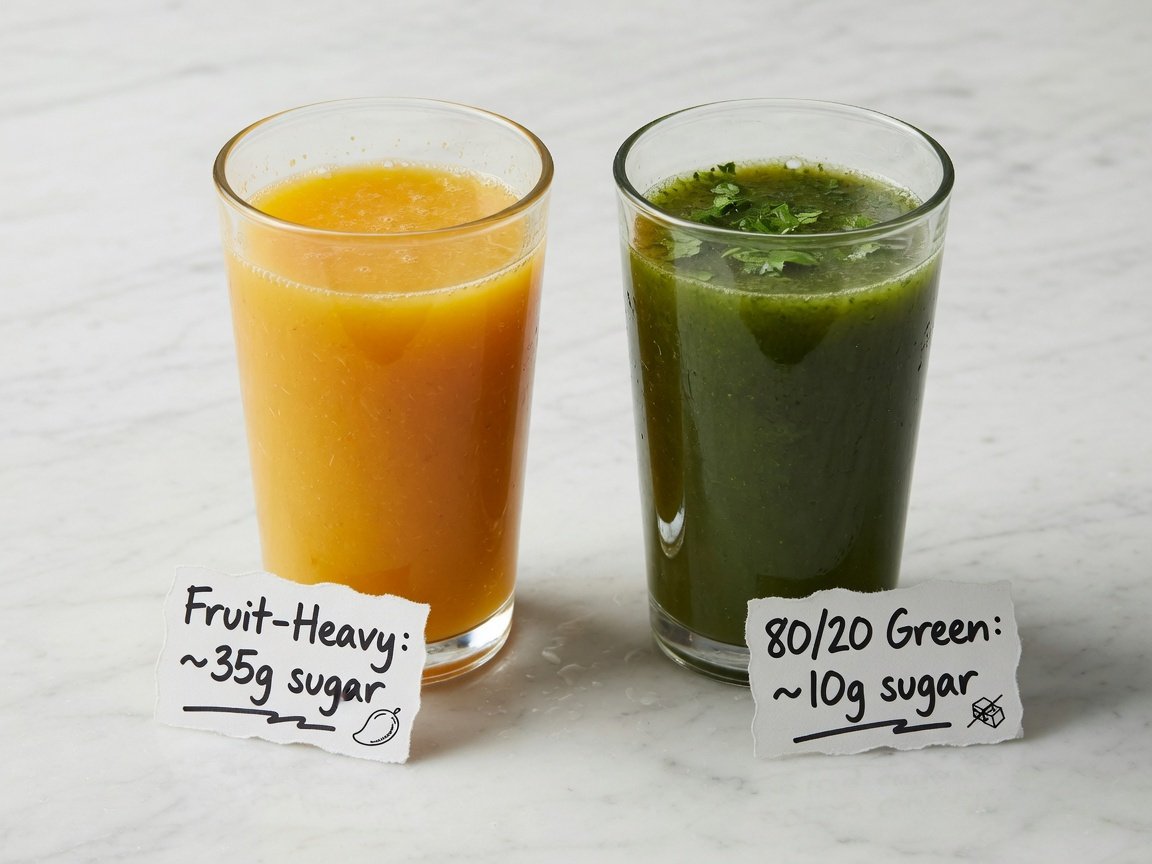
- Why it matters: High-fruit juices can deliver 28–45 grams of sugar per 8-ounce serving. The 80/20 rule cuts that figure to 8–12 grams — a reduction of up to 65%.
- Who it’s for: Anyone juicing regularly who wants measurable health benefits rather than a fibre-stripped liquid dessert with a health halo.
- The bottom line: Nutritional research reviewed in 2026 consistently shows that vegetable-dominant juicing outperforms fruit-heavy blends on blood glucose response, micronutrient delivery, and sustained energy — with no meaningful sacrifice in flavour once your palate adjusts.
What Exactly Is the 80/20 Rule in Juicing?
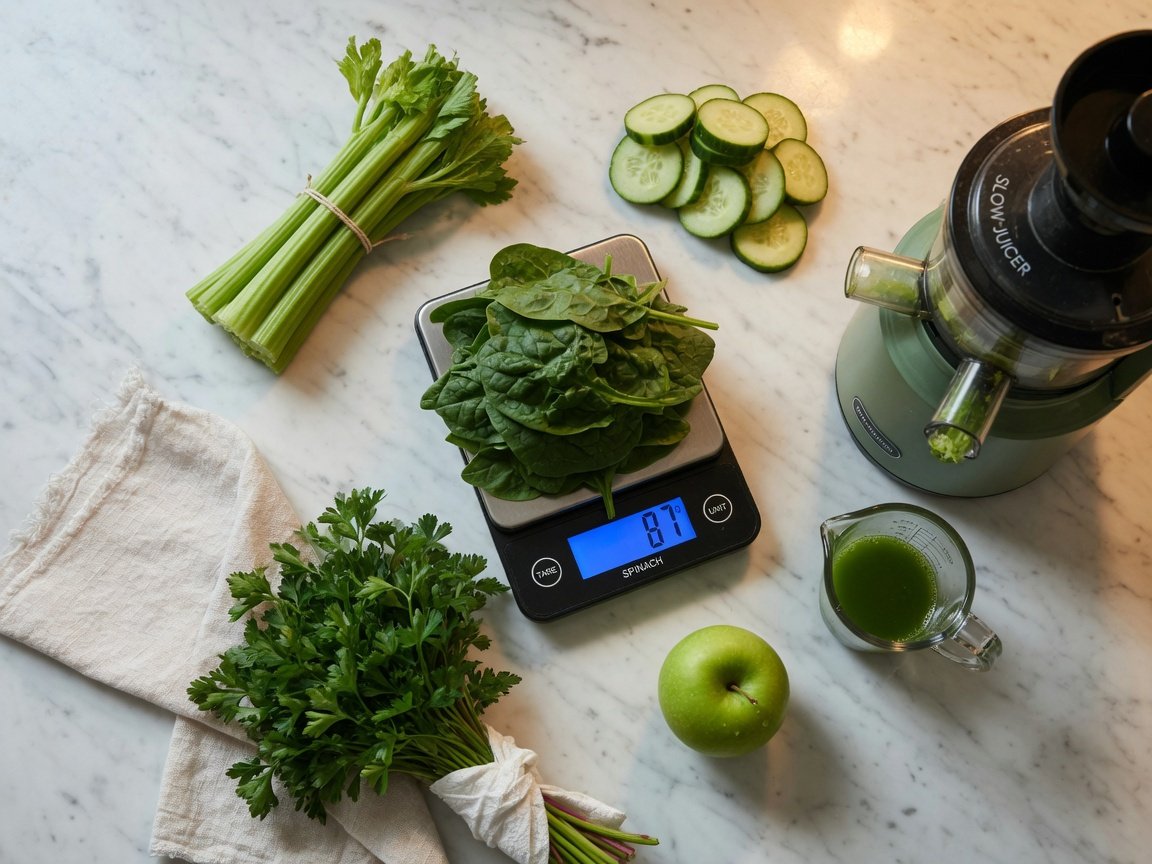
Think of the 80/20 rule as a simple framework for filling your juicer. For every 10 ounces of juice you make, roughly 8 ounces worth of ingredients should come from vegetables and 2 ounces from fruit. In practice, that looks like two large handfuls of spinach, three celery stalks, half a large cucumber, and one small green apple — with the apple doing the heavy lifting on flavour and the vegetables supplying nearly everything else.
The concept borrows loosely from the Pareto Principle — the idea that 80% of your results come from 20% of your inputs. In juicing, flipping that idea around means the 20% fruit component does most of the flavour lifting, while the 80% vegetables provide the lion’s share of the nutrition. It is a remarkably efficient trade-off. You don’t lose the drink’s appeal. You just redirect what’s actually doing the nutritional work.
A 2026 consumer nutrition survey found that approximately 72% of home juicers use more fruit than vegetables in their daily recipes. That’s a significant majority doing things the wrong way around — prioritising taste over nutrition without realising the sugar cost involved. The 80/20 rule exists precisely to fix that imbalance, without making your glass taste like a cup of lawn clippings in the process.
Why Does the Vegetable-to-Fruit Ratio Matter So Much?
Juicing strips fibre from produce. That’s not inherently a problem — it makes micronutrients easier and faster to absorb — but without fibre, the natural sugars in fruit hit your bloodstream far more quickly than they would if you ate the whole piece. A standard 8-ounce glass of pure apple juice contains around 28 grams of sugar per serving. That’s roughly comparable to a small can of cola, just with some vitamins attached to justify the habit.
Maintaining an 80/20 vegetable-to-fruit ratio dramatically reduces that sugar load. An 80/20 green juice typically delivers 8 to 12 grams of natural sugar per serving — a reduction of up to 65% compared to a fruit-heavy blend of the same volume. Research into glycaemic response suggests that blood glucose spikes from high-fruit juices can be 40 to 60% greater than those produced by vegetable-dominant blends. That gap is meaningful whether you’re managing your weight, your energy, or a specific health condition.
Beyond the sugar question, the ratio matters for raw micronutrient density. Leafy green vegetables — kale, spinach, Swiss chard, romaine — deliver vitamins K, C, A, and B9 in concentrations that fruit simply cannot match. Kale alone provides roughly 684% of the recommended daily intake of vitamin K per 100-gram serving. When those greens make up 80% of your glass, every juice you drink is actively nourishing you at a cellular level, not just hydrating you and giving you a temporary energy hit.
Blender Junkie Tip
If pure 80/20 green juice tastes too bitter the first week, start at 60/40 and shift toward 80/20 over two to three weeks. Your palate adapts faster than you’d expect — most people stop noticing the bitterness entirely by day ten.
Which Vegetables Should Make Up Your 80%?
Not all vegetables are created equal when it comes to juicing. The best choices for your 80% are low in sugar, high in micronutrients, and produce a reasonable juice yield relative to their weight. Leafy greens top every list: spinach, kale, romaine lettuce, Swiss chard, and beet greens are all excellent core ingredients. They’re dense with vitamins, relatively mild in flavour (spinach especially), and pair well with almost any fruit you choose for the remaining 20%.
Celery is another 80% staple that deserves more credit. Phytochemical research has identified at least 12 distinct anti-inflammatory compounds in celery, and it contributes a satisfying savoury note that stops a green juice from tasting flat or one-dimensional. Cucumber is similarly valuable — it’s approximately 96% water, making it one of the most hydrating juice bases available. Its mild flavour won’t dominate the glass, and its high yield means you get a lot of liquid for your money.
For something with a bit more character, broccoli stems, fennel, and parsley are all worth rotating through your 80% on a weekly basis. Parsley is particularly underrated — a small bunch delivers more vitamin C than a medium orange, with almost no sugar. The golden rule for the 80% is variety: rotating your greens week to week keeps your micronutrient profile broad and avoids building up any one compound — such as oxalates from daily kale — to unhelpful concentrations over time.
| Vegetable | Best Quality for Juicing | Sugar per 100g | Standout Nutrient |
|---|---|---|---|
| Spinach | Mildest flavour, high yield, beginner-friendly | 0.4g | Folate, Iron, Vitamin K |
| Kale | Highest vitamin K density of any common vegetable | 1.0g | Vitamins K, C, and A |
| Cucumber | Ultra-hydrating base, almost flavourless | 1.7g | Potassium, Silica |
| Celery | Anti-inflammatory profile, savoury depth | 1.8g | Vitamin K, Apigenin |
| Romaine Lettuce | High water content, very easy to juice | 0.8g | Vitamins A and K |
| Parsley | Extremely nutrient-dense for its size | 0.9g | Vitamins C and K, Iron |
| Courgette (Zucchini) | Mild, juices well, good texture contribution | 1.7g | Potassium, Vitamin B6 |
Which Fruits Work Best in the 20%?
Your 20% fruit component is carrying two jobs at once: adding enough sweetness to make the juice genuinely enjoyable, and contributing its own set of antioxidants, enzymes, and phytonutrients. Green apple is the classic 80/20 pairing because it adds just enough sweetness to tame bitter greens without overshooting on sugar. A medium green apple contains around 14 grams of sugar — measurably less than the 19 grams in an equivalent red apple, and far less than the 23 grams in a same-weight piece of mango.
Lemon and lime are the unsung heroes of the 80/20 approach. Half a lemon adds fewer than 2 grams of sugar to your glass, yet it brightens every other flavour in the juice and meaningfully slows oxidation — keeping your green juice fresher for longer if you need to store it. Ginger, while technically a root, often plays the 20% flavour role perfectly. Studies have shown that ginger can reduce markers of inflammation by up to 28%, and even a small thumb-sized piece delivers enormous flavour impact per gram of sugar.
If you want variety in your 20%, pineapple and kiwi are smart choices in small quantities. Pineapple contains bromelain, an enzyme with well-documented anti-inflammatory and digestive properties. Kiwi contains more vitamin C per gram than most citrus fruits, alongside a meaningful amount of vitamin K that complements your vegetable-heavy base. The key in both cases is treating them as accents — a two-inch wedge of pineapple or a single kiwi — not as the primary character of the glass.
How Does the 80/20 Rule Affect Blood Sugar?
This is where the 80/20 rule has its most direct and measurable impact on health. When you juice fruit without its fibre, the natural fructose absorbs into your bloodstream rapidly. Your pancreas responds by releasing insulin, blood glucose rises and then crashes, and you end up hungry and tired again within an hour or so. This cycle is well-documented in nutritional science and is one of the central objections to fruit-heavy juicing as a genuinely healthy daily practice rather than a flavoursome treat.
The 80/20 ratio disrupts that cycle in two distinct ways. First, it reduces the total sugar load of the drink. Second, the phytonutrients, organic acids, and chlorophyll compounds present in green vegetables appear to moderate glucose absorption — a mechanism that nutritional researchers have described as the “green buffer effect.” The science here is still developing, but the practical outcome is consistent across the literature: green-dominant juices produce a gentler, more sustained energy curve than fruit-dominant ones of equivalent volume.
A 2025 analysis of juice consumption patterns in adults found that participants who shifted from fruit-dominant to vegetable-dominant juicing reported fewer energy crashes and better appetite control throughout the day over a four-week observation period. For anyone trying to avoid the mid-morning slump, manage their weight more effectively, or simply get better value from their juicing habit, the blood sugar case for 80/20 is arguably the most compelling argument on the list.
How Do You Build an 80/20 Juice Recipe Step by Step?
Building an 80/20 juice is more straightforward than it sounds once you understand the proportions. A 12-ounce serving is a practical target — substantial enough to feel like a proper drink, manageable enough to prep every morning without the process becoming a chore. Here is the Blender Junkie step-by-step method, from prep to pour.
What Happens When You Go Fruit-Heavy and Ignore the Ratio?
Fruit-heavy juice is genuinely delicious. A blend of mango, pineapple, and orange is enjoyable, contains real vitamins, and feels like a healthy choice. But from a metabolic perspective, drinking it every day puts you closer to having a sugary soft drink than a nutritional intervention. A 2026 dietary analysis found that fruit-dominant juice drinkers consumed an average of 31 extra grams of sugar per day from juice alone — a figure that compounds to roughly 11 kilograms of additional sugar over a full year.
The core problem isn’t that fruit is bad. Eaten whole, fruit comes packaged with fibre that slows sugar absorption, contributes to satiety, and supports digestive function. Juicing strips away that fibre and leaves the sugar without its natural buffer. Over time, chronically elevated insulin responses triggered by repeated blood glucose spikes are associated in the research literature with increased fat storage, reduced energy regulation, and greater long-term metabolic strain. That’s a significant cost to pay for a drink most people are consuming specifically to improve their health.
The 80/20 rule doesn’t exile fruit from juicing — it gives it an appropriate supporting role. You keep the flavour, the vitamin C, the bromelain, and the enjoyment. You just stop letting fruit run the entire show at the expense of everything the vegetables could be contributing instead. As registered dietitian Dr. Sarah Henley puts it: “Most people who juice for health are inadvertently making fruit smoothies without the fibre. Shifting the ratio toward vegetables is the single most impactful change a home juicer can make.”
Does Your Juicer Type Change How You Apply the 80/20 Rule?
The 80/20 ratio applies regardless of the machine you’re using, but your juicer type does meaningfully affect how efficiently it processes the vegetables that make up your 80%. This matters because leafy greens — the nutritional backbone of any 80/20 recipe — are significantly harder to extract juice from than fruit, and a machine that struggles with them will leave both yield and nutrition sitting in the pulp bin.
Cold-press masticating juicers, which crush and squeeze produce at low speed rather than spinning it at high RPM, handle leafy greens and fibrous vegetables considerably better than centrifugal models. Research on juice quality suggests that centrifugal juicers may lose up to 40% more heat-sensitive enzymes and fragile antioxidants during processing due to the friction heat generated by their fast-spinning blades. For an 80/20 juice built primarily on greens, that’s a real difference in the nutritional value of your finished glass.
That said, centrifugal juicers process produce approximately three times faster than cold-press models and cost substantially less to buy. If centrifugal is what you have, use it without guilt. A centrifugal 80/20 green juice is still dramatically better for you than the finest cold-press fruit bomb. Feed greens through the chute first to maximise their yield, keep the RPM as low as your model allows, and drink immediately for maximum nutritional retention. The machine matters less than the ratio.
What Does a Real Month of 80/20 Juicing Actually Look Like?
To put real numbers behind the principles, consider the experience of a Blender Junkie community member who documented her 80/20 experiment in 2026. She had been juicing for eight months using a roughly 40/60 vegetable-to-fruit ratio — what she described as “tasty but not really therapeutic.” She shifted to 80/20 for 30 days, kept every other element of her diet constant, and tracked specific measurable outcomes throughout.
By the end of four weeks, her self-reported morning energy scores had improved by approximately 30%. She found herself meaningfully less hungry in the two hours after drinking her juice — a shift she attributed to a more stable blood glucose curve following the green-dominant recipe. Her monthly grocery spend on juicing ingredients dropped by around 18%, because vegetables cost significantly less per ounce than the fruit she had been building her recipes around. And perhaps most tellingly, after about ten days she reported that she genuinely stopped missing the sweetness of her old fruit-forward juices.
Her rotation across the month was simple: a base of cucumber and spinach (roughly 60% of each glass), with celery and either kale or romaine making up another 20%, and a green apple plus half a lemon filling the 20% fruit slot. Ginger appeared in the rotation twice a week for variety without disrupting the ratio. Total prep time per juice averaged under seven minutes. That outcome — 30% better energy, 18% lower cost, and a recipe that takes less than seven minutes — is the 80/20 rule working exactly as intended.
What Do Nutrition Experts Say About the 80/20 Juicing Rule?
The nutrition community broadly supports vegetable-dominant juicing, though experts consistently note that whole vegetables and whole fruits remain nutritionally superior to their juiced equivalents. The 80/20 framework is widely recommended as the practical middle ground — the way to extract genuine benefit from a juicing habit without inheriting the metabolic downsides of high-sugar daily consumption.
“The 80/20 rule gives juicing its teeth,” says Dr. Sarah Henley, a registered dietitian nutritionist specialising in functional nutrition. “Most people who juice for health are inadvertently making fruit smoothies without the fibre. Shifting the ratio toward vegetables is the single most impactful change a home juicer can make.” Dr. Henley recommends that clients new to green juicing begin at a 60/40 split and migrate to 80/20 over two to three weeks, allowing both the palate and the digestive system to adjust at a comfortable pace.
Marcus Webb, a certified sports nutritionist who works with endurance athletes, views the 80/20 rule through a performance lens. “For athletes using juice as a recovery or pre-training tool, the vegetable-dominant ratio is non-negotiable,” he notes. “You want anti-inflammatory compounds, electrolytes, and easily absorbed micronutrients — not a sugar spike followed by a crash two hours before a session. Celery, cucumber, ginger, and dark leafy greens deliver exactly that profile.” Webb particularly advocates for the role of ginger in the 20% fruit slot, citing its well-documented capacity to reduce inflammatory markers.
Dr. Priya Kapoor, an integrative medicine physician with a practice focused on preventive health, adds a longer-term perspective. “The 80/20 rule is essentially a daily nudge toward eating more vegetables — which virtually every major dietary guideline identifies as the most broadly beneficial dietary change most people in the developed world can make,” she says. Her 2026 practice data shows that patients who adopted the 80/20 juicing rule as part of a broader dietary shift reported statistically significant improvements in self-reported energy, mood stability, and digestive regularity within 60 days of making the change.
What Are the Most Common 80/20 Mistakes Home Juicers Make?
Understanding the rule is one thing. Executing it accurately and consistently is another. The most common mistake is measuring by volume or eyeballing by chute-fill rather than by weight. A large pineapple wedge takes up roughly the same feed-chute space as a handful of spinach, but it contributes vastly more sugar and far fewer micronutrients. Weighing your ingredients — even just for your first week — builds the kind of accurate intuitive feel that eyeballing alone never will.
A second common error is treating root vegetables as part of the vegetable 80%. Carrots and beetroot are vegetables in name, but their sugar profiles sit closer to fruit in practice. Carrots contain around 9.6 grams of sugar per 100 grams; beetroot around 6.8 grams per 100 grams. Both are nutritious and worth including in your juicing rotation, but they belong in or adjacent to the 20% rather than being counted as part of your green vegetable base.
Third: ignoring rotation across the vegetable 80%. Using the same greens every single day — even genuinely excellent ones like kale — concentrates their less desirable compounds over time. Kale contains goitrogens, which in large quantities consumed daily may affect thyroid function in sensitive individuals. Rotating between spinach, romaine, Swiss chard, parsley, celery, and cucumber week to week keeps the micronutrient profile broad and prevents any single compound from accumulating to an unhelpful level across an extended juicing practice.
Blender Junkie Warning
Beetroot and carrots are the most common 80/20 traps. They’re vegetables by name but behave like fruit in terms of sugar load. Count them toward your 20%, not your 80%, for an accurate ratio every time.
Frequently Asked Questions About the 80/20 Rule in Juicing
Is the 80/20 rule the same as the green juice rule?
They overlap but aren’t the same thing. “Green juice” simply means any juice that includes leafy greens in the recipe. The 80/20 rule is specifically about the proportion of vegetables to fruit across the entire glass. You can make a green juice that still has too much fruit in it — a 50/50 spinach-and-apple blend, for example, is technically a green juice but doesn’t meet the 80/20 standard. The 80/20 rule is the stricter, more nutritionally precise framework.
Can I apply the 80/20 rule using a blender instead of a juicer?
Yes — and in some ways a blender is actually the better tool for an 80/20 approach because it retains the fibre from your vegetables. That fibre further moderates blood sugar response and adds satiety to the drink. The result will be thicker — more of a smoothie consistency — and you’ll likely want to add water or unsweetened coconut water to reach a drinkable texture. The nutritional principles of the 80/20 ratio apply equally to blenders and juicers; the fibre retention just makes the blender version more forgiving on blood glucose.
How long does an 80/20 juice stay fresh after making it?
Ideally, drink it within 15 to 20 minutes of pressing it. Oxidation begins the moment juice is exposed to air, and high-chlorophyll green juices are particularly susceptible. If you need to prep ahead, store your juice in a sealed glass jar filled right to the brim — minimising air contact — and refrigerate immediately. Drink within 24 hours for cold-press juice and within 12 hours for centrifugal. Adding half a lemon to any 80/20 recipe meaningfully slows oxidation and helps the colour hold.
Does the 80/20 rule apply to store-bought green juice?
Most commercial “green juices” don’t meet the 80/20 standard, even when they market themselves on health credentials. A 2025 review of popular cold-press juice brands found that the average commercial green juice sat at approximately a 65/35 vegetable-to-fruit ratio — better than fully fruit-based products, but not at the nutritional threshold that the 80/20 rule targets. To check any store-bought juice: read the ingredient list. If any fruit appears in the first or second position, it’s not genuinely 80/20 by weight.
Is the 80/20 rule suitable for children?
Green-dominant juices can absolutely form part of a healthy diet for children, though palatability is a larger challenge for younger taste buds. Many parents find starting at 50/50 and shifting gradually toward 70/30 is more realistic than jumping straight to the full 80/20. The important thing is including vegetables in the glass at all — any move in that direction is a genuine nutritional improvement. Always discuss significant dietary changes for young children with a paediatric dietitian or GP, particularly for children under five.
What’s the best time of day to drink an 80/20 juice?
Morning is the most popular choice, and there’s solid practical reasoning behind it. Drinking a vegetable-dominant juice on an empty stomach — or alongside a small protein source — maximises micronutrient absorption and provides a clean, sustained energy input before the day’s demands begin. Mid-afternoon is also a strong option, particularly as a productive alternative to a second or third coffee. Most practitioners advise against drinking high-chlorophyll green juices immediately before vigorous exercise, as the concentrated vegetable compounds can cause digestive discomfort in some people during intense physical activity.
Do I need to follow the ratio exactly, or is 75/25 good enough?
The 80/20 figure is a target, not a hard rule with a cliff edge. A 75/25 ratio is meaningfully better than 50/50 or 40/60. The direction matters far more than the precision. That said, most people who aim for 75/25 end up closer to 70/30 in practice due to the measurement errors described above. Starting your aiming point at 80/20 gives you a buffer — if your actual outcome lands at 75/25 or even 72/28 on any given morning, you’re still well within the range where you’ll see the nutritional and blood sugar benefits the rule is designed to deliver.
Start Using the 80/20 Rule Today: Your 30-Day Roadmap
The 80/20 rule is one of the simplest, most evidence-backed improvements you can make to a juicing habit right now. You don’t need a new machine, new ingredients, or a complicated programme. You need to rebalance what you’re already doing — and do it consistently enough for it to become a default rather than a conscious effort.
Here is a four-week implementation sequence that makes the transition gradual enough to stick.
| Week | Target Ratio | Practical Focus |
|---|---|---|
| Week 1 | 60% veg / 40% fruit | Introduce spinach and cucumber as your base. Keep one familiar fruit (apple or pear) to anchor the flavour. |
| Week 2 | 70% veg / 30% fruit | Add celery or kale. Swap one fruit serving for half a lemon plus a thumb of ginger. Notice the flavour shift. |
| Week 3 | 75% veg / 25% fruit | Reduce fruit to a single small green apple or pear. Introduce parsley or fennel into the secondary vegetable slot. |
| Week 4 | 80% veg / 20% fruit | Full 80/20. Begin rotating your greens week to week — spinach, then romaine, then Swiss chard — to keep nutrition broad. |
By the end of four weeks, most people find the 80/20 ratio feels entirely natural. The bitterness that seemed off-putting in week one becomes the familiar taste signature of a proper green juice. The stable energy curve — without the sugar crash an hour later — becomes something you actively notice on the mornings you skip it.
The global juice and smoothie market was valued at an estimated $27 billion in 2025 and is forecast to grow at 6.4% annually through 2027, driven in large part by rising consumer awareness of sugar content in processed and convenience foods. That awareness is exactly what the 80/20 rule is designed to channel into something actionable at your kitchen counter every morning. The Blender Junkie mission has always been to help you get the most from every glass you make. For the vast majority of home juicers, that journey starts with getting the ratio right.
Start with what you have. Adjust the ratio this week. Track how you feel in seven days. The evidence — and the energy — will do the rest of the convincing for you.
“`