
We’ve been testing handheld food blenders for months, and honestly, they’re game-changers for busy kitchens. They’ll save you time on everything from soups to smoothies without the hassle of bulky equipment. What’s impressive isn’t just their speed—it’s how these compact tools deliver professional results with minimal cleanup. Well, most of them anyway. Some models definitely outperform others, especially when it comes to battery life and ergonomics. So which ones are actually worth your money?
Top-Rated Immersion Blenders of 2023
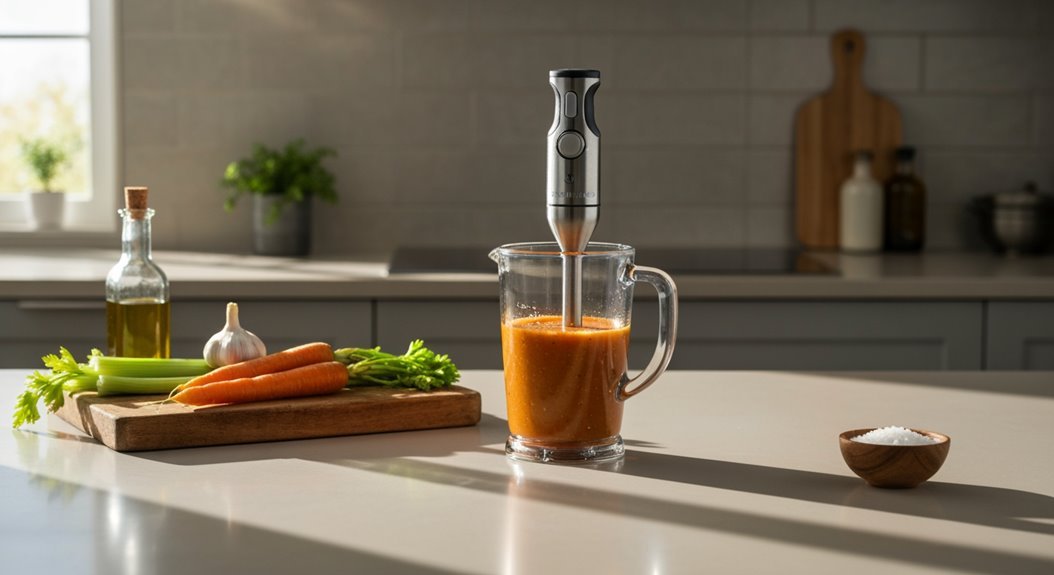
When searching for the best handheld food blenders in 2023, we’ve found that immersion blenders have really upped their game. The top contenders offer impressive features that make kitchen tasks a breeze.

The All-Clad stands out with its powerful 600-watt motor and variable speeds.
While Breville’s Control Grip reduces splattering—a feature we can’t live without.
Vitamix’s 625-watt option includes a thoughtful plastic head cover that protects your cookware during use.
What’s often overlooked is warranty coverage—Breville and Vitamix typically offer more generous terms than budget models.
And don’t forget about color options! The Beautiful by Drew Barrymore line comes in stylish finishes that’ll complement your kitchen décor, unlike the standard black or silver of professional models.
For everyday use, we think the extra investment in a premium model pays off. High-performance blenders can also handle more demanding tasks, making them a worthwhile choice for versatile kitchen use.
Key Features to Look for in Handheld Blenders
We’ve found that choosing the right handheld blender boils down to a few critical features that’ll make or break your kitchen experience. When shopping, you’ll want to think about the power and speed options. Variable controls let you adjust from a gentle mix to high-powered pureeing.
Additionally, some models come with multiple speed settings, allowing for more precise control over texture and consistency. The comfort of an ergonomic design matters just as much as performance. Models with versatile attachment compatibility give you more bang for your buck, transforming your immersion blender into a multi-purpose kitchen tool.
Power and Speed Options
While shopping for a handheld blender, you’ll quickly discover that power and speed options aren’t just fancy features—they’re essential for getting the job done right.
We’ve found that motor strength makes all the difference when tackling tough ingredients—models with 600W or higher power can effortlessly crush ice, while those in the 225-300W range might struggle. Um, actually they’ll probably stall completely with fibrous vegetables.
Blending speed versatility is equally important for achieving perfect textures. Think of variable speeds as your texture control panel—15 settings on a Breville gives you incredible precision!
- Higher wattage (600W+) models handle tough ingredients without overheating
- Variable speed controls (10-15 settings) provide precision for different textures
- Turbo/pulse functions offer bursts of power perfect for emulsifying or crushing ice
Ergonomic Design Matters
How much thought have you given to the way your blender feels in your hand? After testing dozens of models, we’ve found ergonomic grip makes all the difference between an enjoyable cooking experience and an uncomfortable one.
The best handheld blenders feature textured or rubberized surfaces that won’t slip—even with wet hands (a common kitchen situation, right?).
We particularly appreciate handle designs with a natural, balanced shape that won’t leave your wrist aching after whipping up that morning smoothie.
Look for models with well-positioned control buttons that your thumb can easily reach without stretching.
And don’t underestimate good weight distribution! A properly balanced blender feels like—well, almost like an extension of your arm rather than a clunky kitchen gadget you’re fighting to control.
Versatile Attachment Compatibility
When it comes to getting the most bang for your buck, a handheld blender with multiple attachment options simply can’t be beat. We’ve found that accessory compatibility transforms a simple blender into a multi-functional kitchen powerhouse.
Look for models that offer attachment variety – from whisks for whipping cream to choppers for quick salsa prep.
- Detachable, dishwasher-safe attachments make cleanup a breeze (trust me, you’ll appreciate this after making tomato soup!)
- Food processor attachments eliminate the need for separate appliances, saving precious counter space
- Milk frothers can turn your morning coffee routine into a cafe-quality experience
The best handheld blenders will grow with your cooking skills, allowing you to tackle everything from basic smoothies to more complex culinary creations without missing a beat.
Budget-Friendly Options That Deliver Results
Three impressive budget-friendly options prove you don’t need to break the bank for quality blending performance. We’ve found the Hamilton Beach 2-Speed Hand Blender to be a remarkable value at just $27-45. Despite its affordability, it handles everything from whipping cream to crushing ice with surprising material durability for the price point.
What we really appreciate is how quietly it operates compared to other budget models—the noise levels won’t wake your household during morning smoothie prep.
It’s lightweight, compact, and comes with useful attachments like a mini chopper and whisk.
Sure, it might heat up if you’re using it for, um, more than a couple minutes straight, but for occasional use, you’ll honestly wonder why anyone spends three times more on fancier models.
Cordless Models for Maximum Convenience
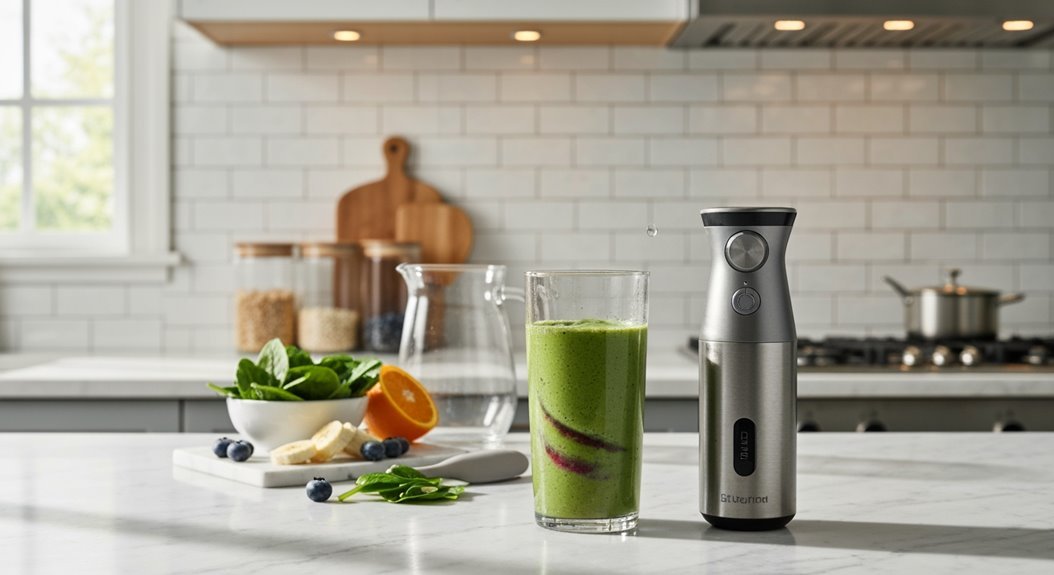
Why hassle with cords when you can enjoy the freedom of cordless blending? We’ve found that models like the KitchenAid Go deliver impressive performance while freeing you from the outlet.
Battery life typically runs 20-30 minutes on a full charge, which is plenty for most kitchen tasks. Charging options have improved dramatically, with many models reaching full power in just a few hours.
- Lightweight design (under 3 pounds) means less arm fatigue when blending thick mixtures.
- Use them literally anywhere—camping trips, picnics, or just moving around your kitchen.
- No more tangled cords knocking things over while you’re trying to work!
We were skeptical at first, but honestly, these cordless wonders handle everyday blending jobs just as well as their corded cousins.
Versatile Attachments and Multi-Purpose Systems
While the raw power of a blender’s motor matters, it’s the attachments that truly unlock its potential in your kitchen arsenal. We’ve found that attachment versatility is what transforms a basic blender into an indispensable tool.
| Attachment | Function | Best For | Cleaning | Compatibility |
|---|---|---|---|---|
| Whisk | Aerating | Cream, eggs | Dishwasher-safe | Most models |
| Chopper | Mincing | Herbs, nuts | Quick-release | System-specific |
| Blending jar | Mixing | Smoothies | Detachable | Universal |
| Measuring cup | Portioning | Sauces | Dishwasher-safe | Varies |
| Grinder | Pulverizing | Coffee, spices | Hand-wash | Premium models |
Multi-purpose functionality is the real game-changer—why buy five appliances when one with the right attachments will do? The Ninja Foodi’s 625W motor, for example, handles everything from ice to fibrous veggies without breaking a sweat.
Handheld vs. Countertop Blenders: When to Use Each
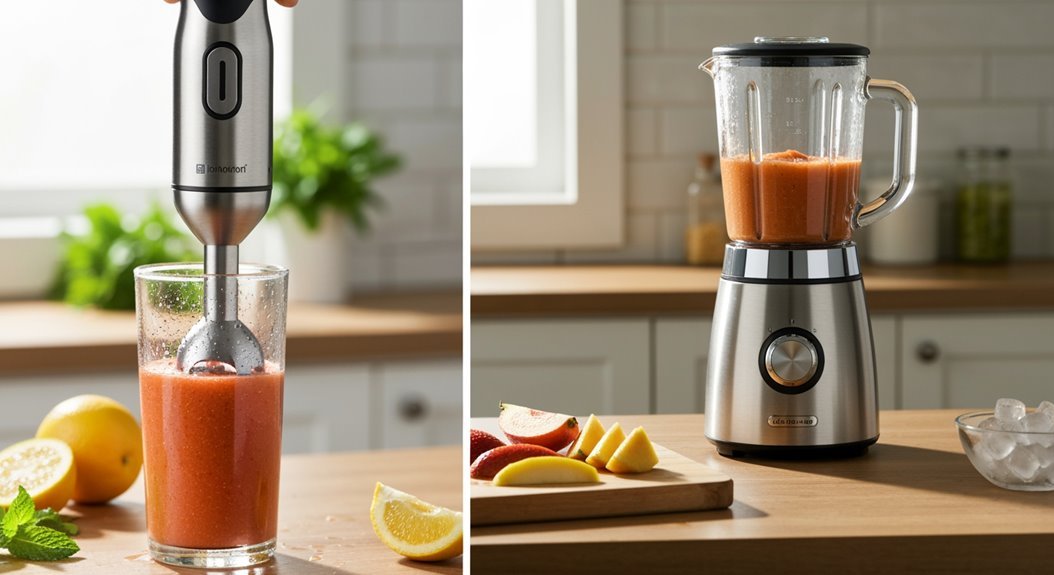
When choosing between handheld and countertop blenders, we’re fundamentally weighing portability against power for different kitchen scenarios.
Handhelds shine for quick tasks like whipping up a single smoothie or blending soup right in the pot, saving us from extra dishes and storage headaches.
On the other hand, if we’re making large batches or need serious muscle for crushing ice and frozen fruits, a countertop blender is probably worth the counter space it demands.
Portability vs. Power
As you’re deciding between handheld and countertop blenders, the age-old debate of portability versus power comes into play.
We’ve found that handheld models win the convenience battle with their lightweight, cordless design and impressive battery capacity. They’re perfect for quick tasks when you don’t want to haul out a bulky appliance.
However, countertop blenders definitely dominate when motor efficiency matters. With wattages exceeding 600W, they handle tough jobs that would strain a handheld device.
- Handhelds shine for in-pot blending and small batches
- Countertop models excel at crushing ice and large-volume tasks
- Battery life in handhelds varies widely, so check specs carefully
In our experience, most kitchens benefit from both. We use our handheld for quick soups and our countertop when making smoothies for the family.
Quick Tasks vs. Volume
Deciding between quick tasks and volume processing ultimately shapes which blender you’ll reach for in your kitchen arsenal. Immersion blenders shine when you need to quickly purée a pot of soup or whip up a small batch of salad dressing right in the mixing bowl.
The cleaning ease alone makes them worth keeping handy—just rinse the shaft rather than disassembling a full countertop model!
For larger batch capacity, though, countertop blenders are truly the workhorses you’ll want.
We’ve found that when making morning smoothies for the family or processing large volumes of ingredients, that extra power (ideally 600W or above) makes all the difference.
You know what they say—sometimes the right tool for the job isn’t about being fancy, it’s about matching your needs with appropriate firepower.
Frequently Asked Questions
How Long Do Immersion Blender Motors Typically Last?
We’ve found that immersion blenders with good motor durability typically last 3-5 years with regular use, though high-quality models can extend their typical lifespan to 7+ years with proper care.
Can Handheld Blenders Effectively Crush Ice for Frozen Drinks?
Isn’t it ironic we buy blenders for everything? Most handheld blenders struggle with ice crushing, as they’re not powerful enough for frozen drinks. We’d recommend dedicated ice crushers instead.
Are Plastic or Metal Shafts Better for Hot Liquids?
Metal shafts are better for hot liquids. They offer superior heat resistance and material durability compared to plastic, which can warp or release chemicals when exposed to high temperatures. We’d recommend metal every time.
How Do I Prevent Splashing When Using an Immersion Blender?
We recommend using a deep container, starting with the blade submerged, and using low speed. This prevents splashing, guarantees machine safety, and avoids motor overheating during longer blending sessions.
Can I Use Handheld Blenders in Non-Stick Cookware Safely?
With a million precautions to take into account, we’d strongly advise against using handheld blenders in non-stick cookware. The metal blades can scratch coatings—a major safety precaution. Regular maintenance tips include choosing plastic-bottomed models instead.