
Do You Really Need a Professional-Grade Immersion Blender?
Some of the links in this article may be affiliate links. If you make a purchase through these links, we may earn a small commission at no extra cost to you. Thank you.

In high-volume kitchens, nothing speeds up service like blending directly in a large pot without transferring hot liquid to another container. That’s where a professional immersion blender earns its keep. But is it essential for every operation? The answer isn’t one-size-fits-all. It hinges on your workflow, output, and how aggressively you push your equipment.
What sets a professional immersion blender apart?
- Power and durability: Designed to run longer at higher speeds without overheating.
- Patented blade geometry and stick lengths tailored for large pots and deep vessels.
- Easy maintenance and serviceability, which reduces downtime during busy service.
Who benefits most?
- High-volume kitchens, stage cooks, and caterers who blend 10–20 liter batches or more per shift.
- Operations prioritizing speed, texture consistency, and minimized transfer risk.
- Teams seeking equipment that resists daily wear, with guaranteed warranty support and parts availability.
Do you save money by sticking to consumer models?
- For occasional home-use or small-batch prep, a consumer immersion blender often suffices and remains more cost-effective.
- In demanding environments, you’ll incur labor, safety, and time costs from frequent transfers, inconsistent textures, or equipment failure if you rely on lighter gear.
The bottom line: evaluate your volume, texture requirements, and downtime tolerance. A professional immersion blender isn’t a luxury for every kitchen, but for operations pushing big batches and tight timelines, it’s a proven asset worth the investment. If you’re unsure, start with a clear test—compare batch consistency, speed, and cleaning time between a commercial unit and your current setup, then scale accordingly.
Be sure to check out my review of the best immersion blenders on the market today.
What Is a Professional Immersion Blender?
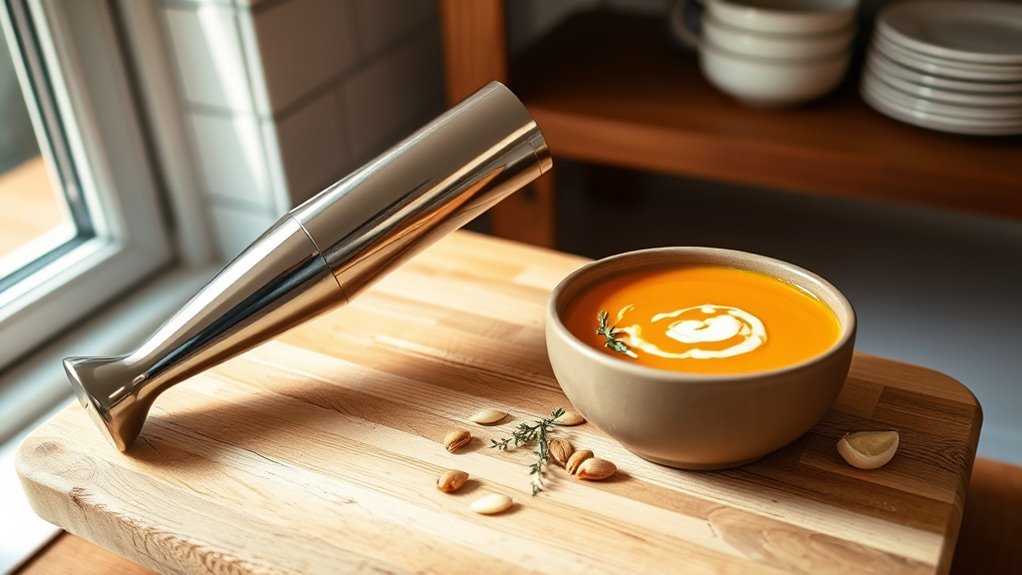
So what exactly separates a professional immersion blender from the one sitting in your kitchen drawer? Well, it’s more than just price. We’re talking about commercial-grade units from brands like Robot Coupe or Waring — machines built for heavy, continuous use in busy foodservice environments. Think of them as the workhorses of the kitchen world, honestly. They handle large-batch sauces, thick emulsions, and high-volume blending without breaking a sweat. Brand durability is a huge factor here. These models feature robust motors, heavy-duty shafts, and warranty coverage that actually reflects their long-term reliability. Prices typically range from $170 to $800 depending on features. They’re not designed for occasional home cooking — they’re built to perform consistently, day after day, under serious pressure. durability considerations
How Professional Models Differ From Home Blenders
How exactly do professional immersion blenders pull ahead of their home counterparts? Well, it really comes down to a few key differences. In the professional vs home debate, it’s mostly about power, build quality, and endurance. Professional models, like those from Robot Coupe or Waring Commercial, feature stronger motors and rugged construction designed to handle large batches daily without burning out.
Home blenders, they’re fine for occasional use — but push them too hard and they’ll give out faster than you’d expect. Think of it like comparing a family sedan to a delivery truck. Both drive, but one’s built for punishment.
The durability vs cost conversation matters here too. Yes, professional units run around $800, but for heavy, consistent workloads, that upfront investment probably saves money long-term. Endurance advantage
Who Actually Needs to Go Professional?
So, who actually needs to make that leap to a professional immersion blender? Well, if you’re running a busy commercial kitchen, a school cafeteria, or any operation that demands high-volume blending day in and day out, a professional model probably isn’t just a luxury — it’s a necessity.
We’re talking about environments where a home-grade unit would burn out fast, and the cost of downtime far outweighs the upfront investment in a premium machine.
Heavy-Duty Blending Needs
Who actually needs to shell out $800 for a commercial immersion blender? Well, if you’re running an institutional kitchen or processing large volumes daily, models like Robot Coupe or Waring Commercial probably make sense. The price comparison between domestic and commercial units is stark, but so is the difference in durability. We’re talking about blenders built to pulverize tough ingredients repeatedly without burning out.
Think of it like buying work boots versus sneakers — the right tool saves you money long-term. Warranty coverage on commercial models also tends to reflect their rugged design, giving you more protection when things get pushed hard. I think for most home cooks, though, a domestic model handles limited daily use just fine. Volume is really the deciding factor here.
Frequent High-Volume Cooking
When does the jump to professional-grade equipment actually make sense? Well, it usually comes down to high volume cooking situations. If you’re regularly blending large batches — soups, sauces, purees — a consumer model will wear out faster than you’d expect. It’s kind of like using a family car for delivery routes. It’ll work, but not for long.
We think durability focused buyers are the ones who truly benefit from going commercial. Brands like Waring are built for continuous heavy use, which means you’re not replacing equipment every year. Maybe you don’t need the $800 Robot Coupe model, but something mid-range commercial probably makes sense. Consider your actual batch sizes first — that’ll tell you everything about what you really need.
Commercial Kitchen Demands
The reality is, not every professional cook actually needs a $800-plus Robot Coupe sitting in their kitchen. But if you’re running a high-volume operation — think soups, emulsions, and sauces cranked out daily — then yeah, it’s worth the investment.
Commercial kitchens have different demands, and procurement considerations matter more than people realize. You’re not just buying a blender; you’re buying reliability under pressure.
The ability to blend directly in large pots alone eliminates serious bottlenecks. And warranty logistics? Don’t overlook them. A broken unit during peak service is, well, a nightmare.
I think the build quality and maintenance compatibility actually separate decent commercial models from the ones that’ll frustrate you within a year. Match the tool to your actual workload.
What Professional Immersion Blenders Can Do That Home Models Can’t
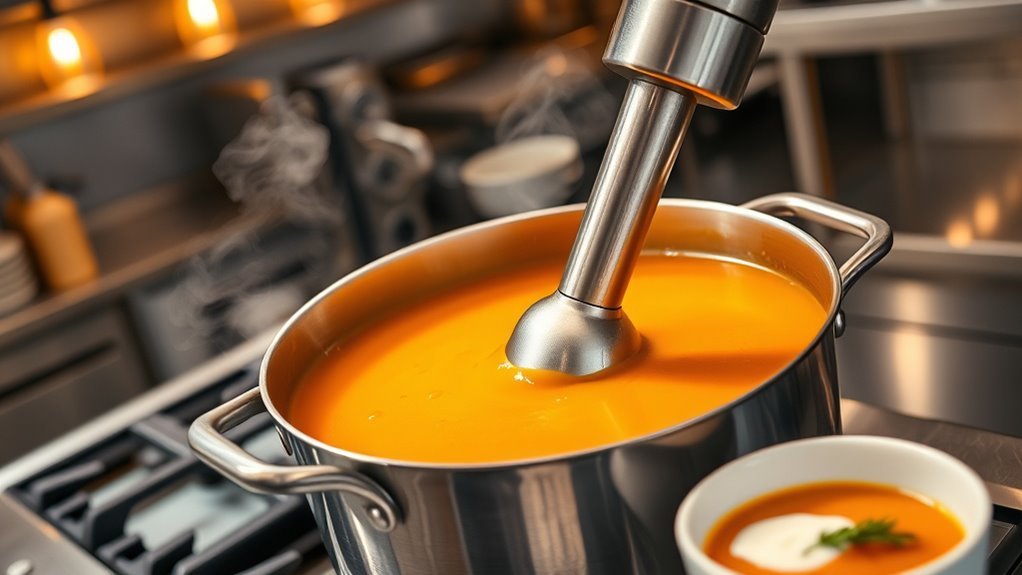
There’s actually a pretty significant gap between what professional immersion blenders can do and what most home models are built for. We’re talking heavy duty motors that power through thick nut butters, date caramels, and large-batch purees without bogging down or overheating. Home units? They’ll struggle, stall, or just burn out faster than you’d expect.
Professional models are also built for continuous use — running shift after shift without needing recovery time. That kind of reliability is honestly hard to put a price/value on if your kitchen depends on consistent output daily. The attachments are sturdier, the emulsions come out smoother, and the overall construction just feels like it’s meant to last. It’s a meaningful difference, not just a marketing one.
What a Professional Immersion Blender Actually Costs
So now that we know what these machines are actually capable of, it’s worth talking about what they’ll run you. Professional immersion blenders sit in a pretty wide price range — models like Robot Coupe can hit around $800, sometimes more. That’s not a typo. Brands like Waring Commercial also fall into that premium territory, and honestly, you’re paying for durability testing that consumer models just don’t go through. These units are built to survive heavy daily punishment in professional kitchens, which is, well, a totally different standard than weekend soup-making. But here’s the thing — not every professional model costs the same. A smaller pro unit might suit your needs without the bigger price tag. So maybe think about your actual volume before committing.
How to Pick the Right Professional Immersion Blender
Picking the right professional immersion blender really comes down to honest self-assessment — how much volume are we actually dealing with, and how often?
A high-volume kitchen probably justifies something like a Robot Coupe, even with steeper price trends pushing models toward $800. But if we’re running a smaller operation, that’s maybe overkill.
Think about attachments too. Choppers and whisks turn one tool into several, which is genuinely useful for sauces and emulsions. Cordless models offer mobility — though they trade some power for it, so weigh that carefully.
Warranty coverage matters more than people realize. A blender that dies in six months isn’t a deal, it’s a headache. Don’t skip reading the fine print.
Bigger isn’t always better; the right fit beats the most impressive spec sheet every time.
Frequently Asked Questions
Is It Worth It to Get an Immersion Blender?
Yes, we think it’s worth it! Immersion blender durability and budget vs performance both matter—they’re versatile, easy to store, and handle soups or emulsions effortlessly, making even affordable models a smart kitchen investment.
What Immersion Blender Do Professional Chefs Use?
We’ve found that professional chefs rely on professional blender brands like Robot Coupe and Waring Commercial. Their immersion blender compatibility with heavy-duty tasks makes them ideal for high-volume kitchen demands we’d recommend exploring.
Can I Use an Immersion Blender for Falafel?
We don’t recommend using an immersion blender for falu falafel—it won’t achieve proper consistency. We’d suggest a food processor instead, as it’ll evenly chop chickpeas into that perfect, cohesive dough we’re all after.
Can You Use an Immersion Blender for Hummus?
Yes, we can use an immersion blender for hummus! The immersion blender benefits include easy small-batch blending and less cleanup, though performance tradeoffs mean it’s slower than a full-size blender for ultra-smooth results.