
We’ve spent countless hours testing blenders in our kitchen, and we’re excited to share what we’ve discovered. A good blender can transform your cooking, but the wrong one might leave you with chunky smoothies and buyer’s remorse. We’ve found some standouts at various price points, from budget-friendly workhorses to professional-grade machines that’ll last for years. Want to know which ones made the cut and why some popular models didn’t measure up?
Some of the links in this article may be affiliate links. If you make a purchase through these links, we may earn a small commission at no extra cost to you. Thank you.

Our Top Rated Blenders for Every Budget
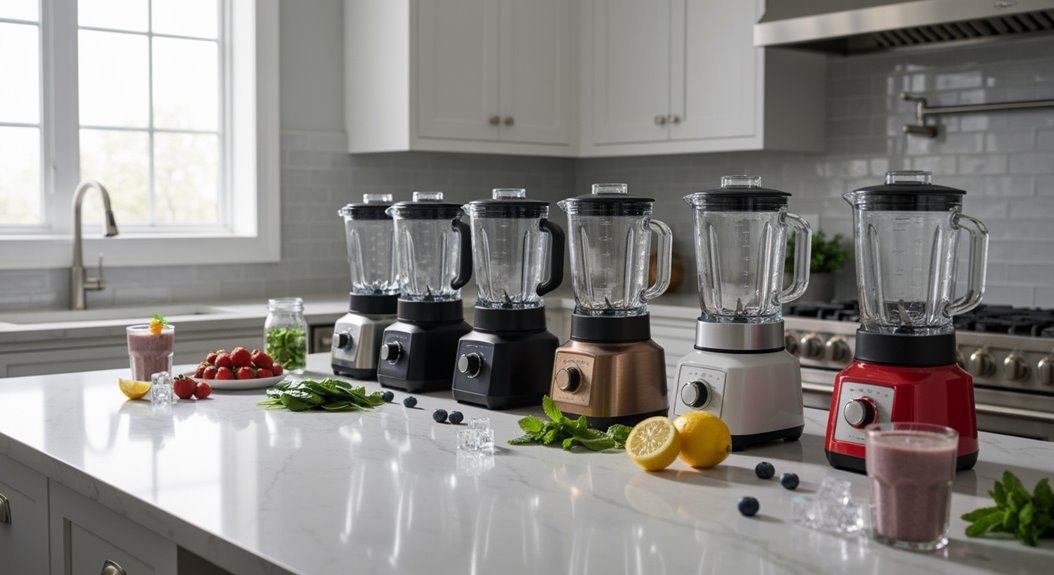
While finding the perfect blender can feel overwhelming with so many options on the market, we’ve done the hard work for you by testing dozens of models across all price points.
For those willing to invest, the Vitamix 5200 and A2500 are standouts, though they’re not exactly quiet operators. The A2500 offers more color options if kitchen aesthetics matter to you.
The Breville Fresh & Furious hits a sweet middle ground with relatively lower noise levels and comes in several attractive finishes.
If you’re budget-conscious, Ninja’s Professional Plus with Auto-iQ performs admirably for most tasks and isn’t as loud as you might expect for the price.
For ultra-affordable options, we like the compact Nutribullet and Magic Bullet models – just don’t expect many color choices or whisper-quiet operation.
High-performance blenders can handle tough ingredients like nuts and seeds effortlessly, producing smoother textures that make a significant difference in your recipes.
Key Features That Make a Great Blender
After exploring our top picks at various price points, you might be wondering what exactly separates the best blenders from the merely adequate ones.
In our testing, we’ve found that power matters—aim for at least 750 watts to handle tough ingredients like frozen berries.
The jar shape is surprisingly essential. We’ve seen that taller, narrower jars (around 4.5 inches in diameter) create better vortexes for smoother results.
And don’t overlook blade durability! Sharp, removable blades made from quality materials make all the difference in performance and cleaning ease.
Variable speed settings and pulse functions give you precise control, which, well, you really need for different textures.
And honestly, a good tamper is worth its weight in gold—it helps with thick mixtures without having to stop the blender mid-blend.
Proper maintenance and understanding motor issues are also crucial, as they influence the longevity and reliable performance of your blender over time.
How We Tested: The ATK Methodology
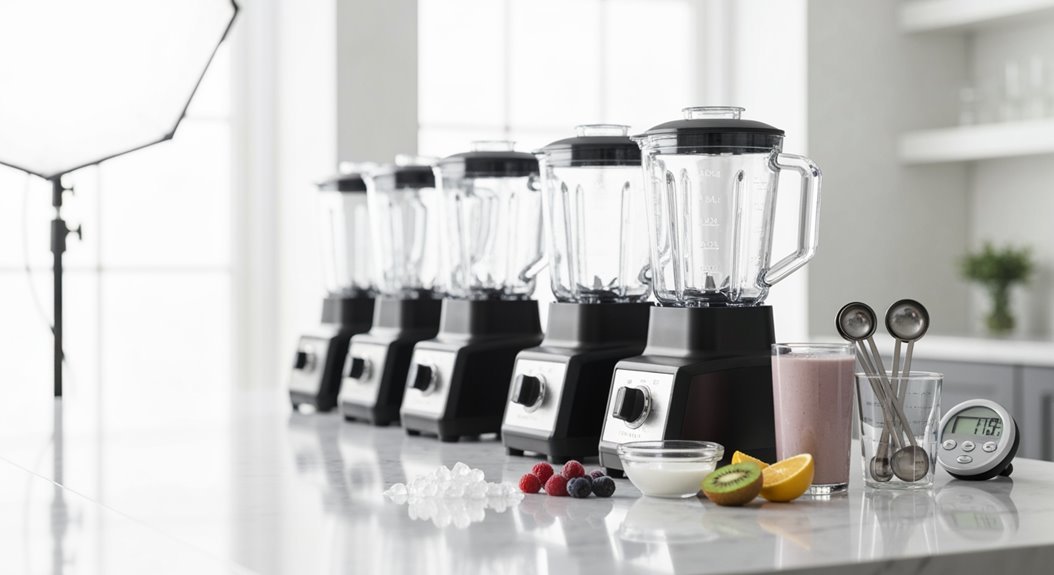
Because we take our blender recommendations seriously, our testing process at America’s Test Kitchen is nothing short of rigorous. We’ve examined the historical context of blender development and industry innovations to design tests that truly matter to home cooks.
For performance, we put each model through challenging trials—blending fibrous kale smoothies, crushing ice for frozen drinks, and pureeing fruits to silky perfection. We also evaluated how comfortable the blenders felt in hand and how intuitive their controls were.
Durability matters too, so we ran motors through up to 25 consecutive smoothie batches. Will they overheat? Well, we found out!
And cleanup—don’t get me started. We checked everything from dishwasher compatibility to how easily those stubborn ingredients could be removed from hard-to-reach spots.
Full-Size Blenders: Performance Comparisons
When it comes to full-size blenders, the difference between mediocre and magnificent often lies in the details. After testing dozens of models, we’re convinced that blade design and motor efficiency are the two most critical factors separating the champions from the challengers.
| Model | Motor Power | Performance Rating |
|---|---|---|
| Vitamix 5200 | 1380 watts | Exceptional |
| Vitamix A2500 | 1440 watts | Outstanding |
| Budget Option | 850 watts | Good |
We found that tall, narrow jars (about 4.5 inches in diameter) consistently created smoother blends by forming a better vortex. You know how frustrating it is when ingredients just spin around without actually blending? Well, that’s what happens with poorly designed models. The high-end options we tested excelled at everything from silky smoothies to perfect purees, with virtually no cavitation issues.
Personal and Immersion Blenders Worth Buying
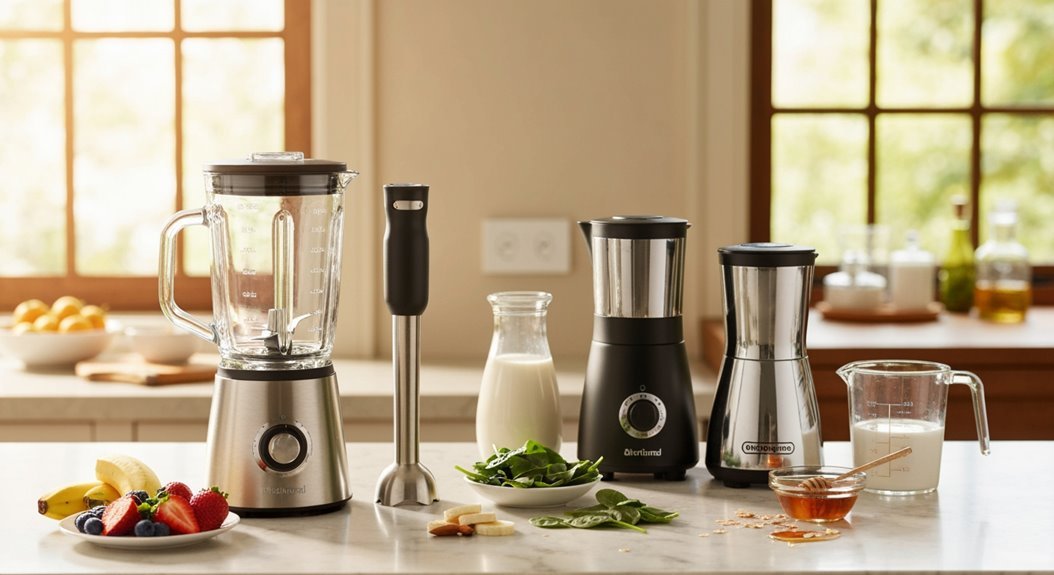
We’ve found that personal and immersion blenders offer amazing convenience for everyday kitchen tasks, though they’ll never match the raw power of their full-sized counterparts.
The best immersion models, like the Braun Multi-Quick 5, balance comfortable handling with efficient blending capability, while personal blenders such as Nutribullet excel at quick, single-serving smoothies you can take on the go.
When choosing these smaller blending tools, we’ve learned that simple controls and ergonomic design matter more than fancy features that you probably won’t use anyway.
Everyday Blending Champions
After years of testing personal and immersion blenders, our team’s discovered that the right everyday blender doesn’t need to cost a fortune or take up precious counter space. We’ve found that Braun’s Multi-Quick 5 Hand Blender offers incredible value with its comfortable grip and effective two-speed operation.
| Model | Best Feature | Color Options |
|---|---|---|
| Nutribullet | 600W power | 5+ colors, quieter operation |
| Breville Control Grip | Bell-shaped guard | Limited colors, moderate noise |
| Braun Multi-Quick 5 | Comfortable grip | 3 options, surprisingly quiet |
When choosing your kitchen companion, we recommend prioritizing models with simple controls and detachable shafts. Trust us, you’ll want to avoid those bulky, underpowered models—they’re just frustrating when tackling fibrous ingredients and, well, nobody enjoys cleaning up unnecessary splatters!
Size vs. Performance Tradeoffs
Although bigger often means better in the blender world, the relationship between size and performance isn’t always straightforward. We’ve found that personal blenders with their compact 20 oz jars offer convenience but sometimes struggle with blade durability when tackling tougher ingredients.
Meanwhile, immersion blenders give you flexibility without sacrificing counter space.
When choosing your perfect blender, consider these key tradeoffs:
- Power vs. Portability: Larger units blend more consistently but weigh more and produce higher noise levels
- Capacity vs. Storage: High-performance models handle bigger batches but demand permanent counter real estate
- Versatility vs. Simplicity: More powerful motors tackle diverse ingredients but, well, they’re usually bulkier and pricier
In our testing, we’ve noticed that the sweet spot often depends on your specific needs rather than simply going bigger.
Common Blender Limitations to Consider
Before investing in a new blender, you’ll want to be aware of the limitations that might derail your kitchen aspirations.
In our testing, we’ve found that budget models under $100 typically lack the power needed for ice crushing or tough ingredients. Blade durability becomes an issue with frequent use, and many bargain blenders produce noise levels that’ll wake your entire household!
We’ve noticed that narrow jars (less than 2 inches wide) frequently trap ingredients, creating uneven results.
Also, don’t be fooled by promises of hot soup or homemade ice cream in underpowered machines—they rarely deliver.
Blenders with less than 750 watts simply struggle with nut butters and fibrous greens.
And those leaky lids? They’re not just annoying but can make your blender practically useless for many everyday tasks.
Which Blender Type Is Right for Your Kitchen Needs
After testing dozens of models, we’ve found that choosing between full-sized and personal blenders really comes down to what you’ll make most often and how many mouths you’re feeding.
If you’re whipping up daily smoothies just for yourself, a personal blender saves counter space and cleanup time. But you’ll want a powerful countertop model for tougher jobs like crushing ice or making nut butters.
We also recommend considering specialty features for specific tasks you do regularly—like preset programs for smoothies or soup if those are your go-to recipes.
Full-Sized vs. Personal
When choosing between a full-sized and personal blender, you’ll need to think about how you’ll actually use it in your daily life. Full-sized models offer design adaptability with their larger capacities and powerful motors, though they do generate higher noise levels during operation.
Personal blenders sacrifice versatility for convenience and portability.
We’ve found these considerations matter most:
- Serving size – Are you blending for one person or the whole family?
- Kitchen space – Small apartments mightn’t accommodate bulky full-sized models.
- Functionality needs – If you’re making nut butters or crushing ice regularly, you’ll want that extra power.
While full-sized blenders offer more options, personal blenders are perfect for on-the-go smoothie lovers.
We think it’s worth having both if you’re serious about blending!
Power vs. Convenience
Although everyone wants a powerful blender, we’ve learned through our testing that raw power isn’t always the most important factor in finding your perfect match.
It’s really about balancing motor strength with user convenience for your specific needs.
If you’re crushing ice daily or making nut butters, yes, that high-powered 1000+ watt beast makes sense. But for most home cooks, we’ve found mid-range models (700-900 watts) hit the sweet spot.
They’re powerful enough for most tasks while offering helpful preset functions that actually make your life easier.
Think about it this way: do you want to spend extra for power you rarely use, or would you prefer something that, well, just works intuitively for your everyday smoothies?
Sometimes convenience trumps raw horsepower in the kitchen.
Specialty Task Considerations
Why are there so many different types of blenders on the market? Well, it’s because different blending tasks require specific tools. When you’re dealing with difficult ingredients like fibrous greens or making emulsions, you’ll need the right equipment for the job.
We’ve found that matching your specific kitchen needs to the right blender makes all the difference:
- Immersion blenders with specialized attachments excel at quick in-pot pureeing of soups and sauces
- High-powered countertop models (the ones with 1000W+) handle tough ingredients like ice and nuts that would burn out smaller motors
- Personal blenders are perfect for morning smoothies, but they’ll struggle with, um, more challenging ingredients
Frequently Asked Questions
What Is the Best Blender According to America’s Test Kitchen?
We’ve found the Vitamix 5200 is their top pick, offering exceptional blending technology and unmatched durability. The A2500 comes in second with its impressive preset functions.
What’s the Best Blender on the Market Right Now?
Like a tornado in a jar, we’d crown the Vitamix 5200 as king of blenders today. Its kitchen appliance ergonomics shine while proper blender upkeep guarantees it’ll outlast cheaper competitors.
What Is the #1 Blender?
The Vitamix 5200 is the #1 blender. We’ve found it’s exceptionally durable with proper blender maintenance, and its standard blender accessories complement its powerful 2-horsepower motor for silky-smooth results every time.
What Is the Best Smoothie Blender at ATK?
Smooth as silk, we’ve found the Vitamix 5200 is ATK’s top smoothie blender. It offers exceptional blender durability that’ll last for years, despite somewhat higher noise levels during operation.