
We’ve all had that moment in the kitchen when we wished our blender could pulverize that stubborn kale stem or turn those frozen berries into something smoother than a grainy mess. Most home cooks don’t realize that the difference between frustration and culinary success often comes down to matching the right blender to specific tasks. Well, maybe it’s not just about horsepower—though that matters—it’s about blade design, container shape, and even how you layer ingredients. The perfect blend is waiting; you just need the right tool.
Some of the links in this article may be affiliate links. If you make a purchase through these links, we may earn a small commission at no extra cost to you. Thank you.

Understanding Different Blender Types and Their Ideal Uses
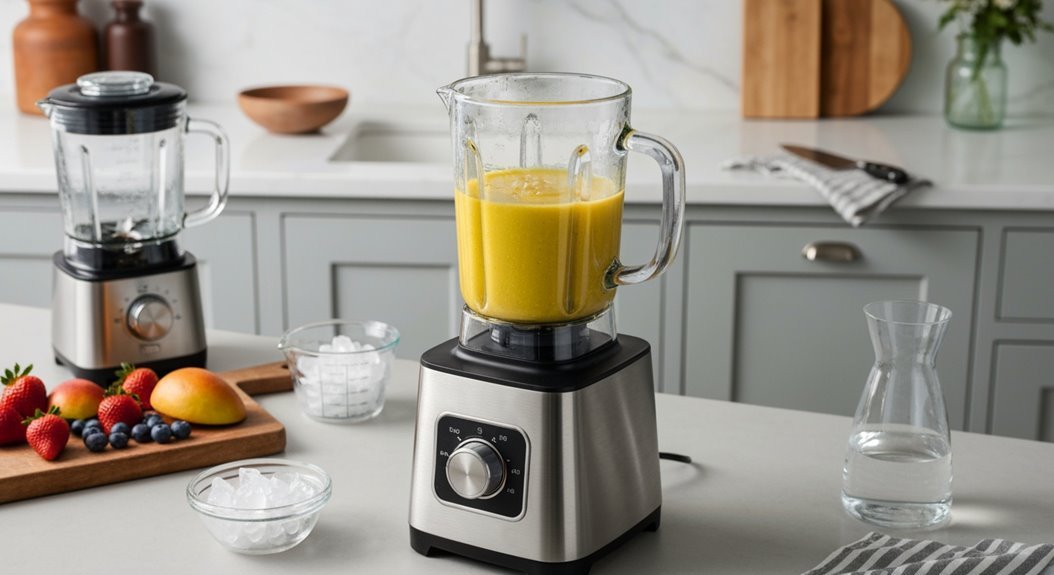
When it comes to choosing a blender, we’re often overwhelmed by the variety of options available in stores and online. Well, let’s break it down into simple categories.
Countertop blenders have evolved dramatically since their historical blender innovations in the early 20th century. Today, they come in three main types: full-sized workhorses for family use, compact personal blenders for smoothies on-the-go, and those high-performance monsters like Vitamix that can pulverize just about anything.
Don’t forget about immersion blenders – those handheld magic wands that let you blend directly in your cooking pot. They’re perfect for soups, I think, and don’t require as many blender accessories as their countertop cousins.
Just remember that if you’re mainly chopping solids rather than blending liquids, you might actually need a food processor instead. High-performance blenders are particularly effective for tough ingredients and achieving smoother textures, making them a versatile choice for many kitchen tasks.
Power and Performance: What the Numbers Really Mean
When we’re shopping for blenders, it’s easy to get caught up in the numbers game – especially wattage – but we’ve found there’s more to the story than raw power. A 1500W motor might sound impressive, but without well-designed blades and efficient motor construction, it won’t necessarily outperform a thoughtfully engineered 800W model. The motor quality and overall design are crucial in delivering consistent performance under load, ensuring your blender can handle tough ingredients effectively. The real magic happens when multiple factors work together: appropriate wattage, smartly designed blades, and motor quality that delivers consistent RPM even under load.
Wattage vs. Actual Performance
Although many shoppers are drawn to high-wattage blenders, the numbers on the box don’t tell the whole story about performance. We’ve found that one of the biggest wattage myths is that higher always equals better blending.
In reality, a 500W blender with well-designed blades might outperform a 1000W model with poor engineering. Performance myths lead many consumers astray when they focus solely on power ratings.
What’s actually happening inside your blender is a complex dance between motor torque, blade design, and container shape. And watch out—manufacturers often advertise peak wattage rather than continuous power, which, um, doesn’t accurately reflect what you’ll experience in daily use.
We’ve seen 700W blenders that crush ice better than 900W models, proving it’s the total package that matters, not just the number.
Understanding RPM Impact
Why do so many shoppers get fixated on wattage when RPM actually tells us more about how a blender will perform? The RPM dynamics—those revolutions per minute—reveal the real story of your blender’s capabilities.
Most home blenders operate between 10,000 and 30,000 RPM, with high-performance models reaching up to 40,000 RPM for silky-smooth results.
Think of blade speed as the workhorse behind crushing ice or turning nuts into butter. But here’s the thing—super high RPMs aren’t always better if the motor can’t keep up.
We’ve found that the sweet spot combines adequate RPM with sufficient wattage. Too high, and you’ll overheat your mixture; too low, and you’re left with chunks.
When shopping, don’t just look at one number—consider how RPM and power work together for your specific blending needs.
Blade Design Matters
Beyond raw power and speed, a blender’s blade design is the unsung hero of effective food processing. We’ve found that blade geometry considerably impacts how well your blender tackles everything from ice to leafy greens.
You know those multi-layered, angled blades? They’re not just for show—they create an efficient vortex that pulls ingredients down for consistent blending.
In our experience, blade durability is probably the most overlooked feature when shopping for blenders. High-quality stainless steel blades maintain their edge over years of use, while cheaper options dull quickly.
Think of blades as the transmission in a car—even the most powerful engine (or motor) won’t perform well if the system can’t effectively transfer that energy to where it’s needed.
We’ve learned this lesson the hard way!
Container Materials and Size: Choosing What Works for You
We’ll now look at what’s holding your smoothies, salsas, and soups – the blender container itself.
Whether you’re considering plastic’s lightweight practicality or glass’s odor-resistant properties, the material choice affects everything from storage to cleaning convenience.
And don’t forget about size – you’ll want to match your container capacity to your typical blending needs, from personal morning smoothies to family-sized batches of soup.
Container Material Comparison
When it comes to selecting a blender container, the material you choose can considerably impact your blending experience and maintenance routine.
We’ve found that both plastic and glass options offer distinct advantages worth considering.
- Plastic containers are lightweight and more forgiving if dropped, but they may absorb odors over time.
- Glass resists staining and won’t retain food smells, though it’s heavier and more breakable.
- Blade durability tends to be better with glass containers as they provide a more stable blending surface.
- Lid sealing is essential regardless of material—look for tight-fitting options that won’t leak.
- Consider your storage space—bulkier glass containers mightn’t fit in smaller cabinets.
In our experience, glass works best for daily use if you don’t mind the weight, while plastic is great for busy households where drops happen!
Capacity Size Selection
Selecting the right blender capacity might seem straightforward, but it’s actually a essential factor that’ll impact your daily blending experience.
We’ve found that matching container size to your typical usage is critical—those 64-ounce models are perfect for family smoothies, while 20-32 ounce containers work better for individual servings or smaller kitchens with limited storage.
Consider container insulation too, especially if you blend frozen ingredients often. Some models actually—well, not actually, but sort of—insulate better than others, keeping smoothies colder longer.
Color options might seem purely aesthetic, but darker containers can hide stains better over time, which is a practical benefit.
We think the wide-mouth designs are non-negotiable for easy cleaning, because nothing’s worse than struggling to reach those stubborn bits stuck at the bottom!
Practical Design Features
As you immerse yourself in the world of blender materials, you’ll quickly discover that not all containers are created equal—each offering distinct advantages that might perfectly match your blending style.
We’ve found that while glass brings elegance and resists those pesky food odors, plastic offers lightweight practicality (and often more color options too!).
When selecting your ideal container, consider these factors:
- Material durability vs. weight trade-offs
- Wide-mouth designs for easier ingredient adding and cleaning
- Capacity that matches your typical serving needs
- Noise levels (which often relate to material and construction)
- Storage space in your kitchen
Essential Features Worth Paying For
While investing in a blender, you’ll want to make sure your money is well-spent on features that actually matter. We’ve found that powerful wattage (1000+ watts) dramatically improves blend quality and versatility. You know how frustrating it’s when chunks remain? That’s history with a high-powered model.
Multiple speed settings, including pulse function, give you precise control over texture—something we think is absolutely essential.
In our experience, durable materials make a huge difference in longevity. Maybe it’s worth splurging on stainless steel blades and BPA-free jars? They’re dishwasher-safe too, which, let’s be honest, is a lifesaver on busy days.
Don’t underestimate noise level—it can be, um, jarring.
Finally, we always recommend models with extensive warranties (7-8 years ideally). They’re like insurance for your kitchen investment.
Budget-Friendly vs. Premium Models: What You Get at Each Price Point

Now that we’ve covered what features are worth your hard-earned money, let’s talk about the price tags attached to them. The gap between budget and premium blenders is pretty significant—and not just in cost.
Budget blenders (<$50) offer basic functionality but might struggle with blend duration for tougher ingredients.
Premium models ($300+) feature powerful motors that cut blending time in half.
Noise levels tend to be much higher in cheaper models—something to take into account if you’re an early morning smoothie person.
Warranty protection jumps from about 1 year for budget options to 7+ years for high-end brands.
Container materials improve dramatically with price—from potentially cloudy plastic to durable glass or stainless steel.
We’ve found that for occasional blending, budget models work fine, but daily users might find the premium investment worthwhile.
Space-Saving Options for Small Kitchens
Living with limited kitchen space doesn’t mean you have to compromise on blending power. We’ve found that compact personal blenders under 10 inches tall can easily slip into drawers when not in use, and many come with jars that double as travel cups—perfect for taking your morning smoothie on the go!
Immersion blenders are probably our favorite space-savers. They’re incredibly versatile (some even include milk frother attachments) and take up practically no counter space.
You know what’s also great? The advanced juicing technology in today’s compact models delivers the same results as their bulkier counterparts.
When shopping, look for models with removable cords and lightweight designs. This might seem like a small detail, but trust us—it makes a huge difference when you’re constantly tucking your blender away between uses.
The Perfect Layering Technique for Optimal Blending Results
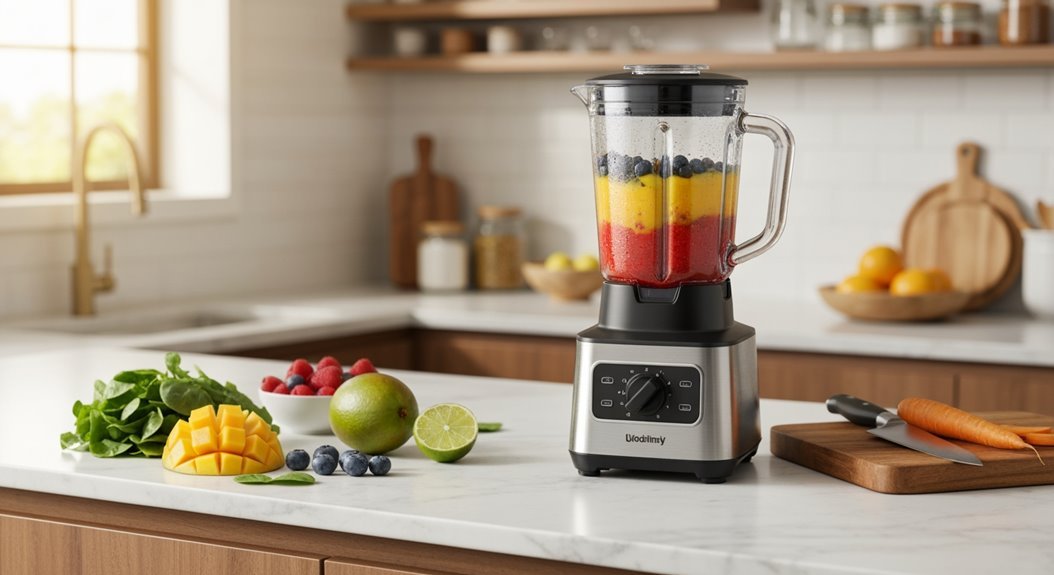
Even the most powerful blender can’t work its magic if you’re tossing ingredients in randomly. We’ve discovered that a strategic layering approach makes all the difference in achieving silky-smooth results.
Your ingredient order matters more than you might think!
Follow our foolproof layering strategy:
- Pour liquids in first to create a vortex that pulls other ingredients down
- Position leafy greens and herbs near the blades for thorough breakdown
- Add softer ingredients like bananas or yogurt next
- Drop in harder items (nuts, frozen fruit) after the softer stuff
- Sprinkle powders on top once blending has begun to prevent clumping
For personal blenders, you’ll actually want to flip this order—it’s counterintuitive, but trust us, it works wonders!
Cleaning and Maintenance: Extending Your Blender’s Lifespan
Your perfectly layered ingredients won’t blend so beautifully if your blender isn’t properly maintained. We’ve found that establishing a regular cleaning routine is the cornerstone of good blender maintenance. After each use, take a few minutes to disassemble the parts and wash them with warm, soapy water—it’s so much easier than dealing with dried-on residue later!
For quick cleaning between uses, try filling the jar halfway with warm water, adding a drop of dish soap, and running it on low for a few seconds. Works like magic! Just remember, harsh scrubbers are your blender’s worst enemy. They’ll scratch the container faster than you can say “smoothie.”
Don’t forget to check which parts are dishwasher-safe and periodically inspect those blades—they might need replacing.
Frequently Asked Questions
Which Blender Is Best for Everything?
We recommend high-performance blenders with 1000+ watts for everything. They’ll deliver perfect smoothie consistency across all recipes. Look for dishwasher-safe parts for easy cleaning tips – quick rinse cycles work wonders!
How Do You Choose the Right Blender?
We’ve found that investing in a high-powered Vitamix transformed our morning routines. When choosing a blender, we consider our needs, kitchen space, safety tips like secure lids, and regular blender maintenance to guarantee longevity.
How Do I Know Which Blender Is Best?
We’ll know the best blender by testing it on various ingredients, evaluating durability, and considering our specific needs. Regular blender maintenance extends lifespan, while mastering blending techniques ensures ideal performance for our kitchen tasks.
How Many Watts Should a Good Blender Have?
We recommend 500-800 watts for most households. Higher motor power (1000+ watts) handles tougher ingredients, while blade versatility is equally important. Lower-powered models may struggle with ice and dense mixtures.