
Just yesterday, we were debating which blender makes the perfect soup in our kitchen. We’ve tried both immersion and countertop models, and honestly, they each have their sweet spots. Immersion blenders let you blend right in the pot—no messy transfers when everything’s hot. But countertops? They’ll give you that silky-smooth restaurant texture that’s hard to beat. The question isn’t which one’s better, but which one fits your cooking style.
The Power Battle: Comparing Motor Strength for Soup Consistency
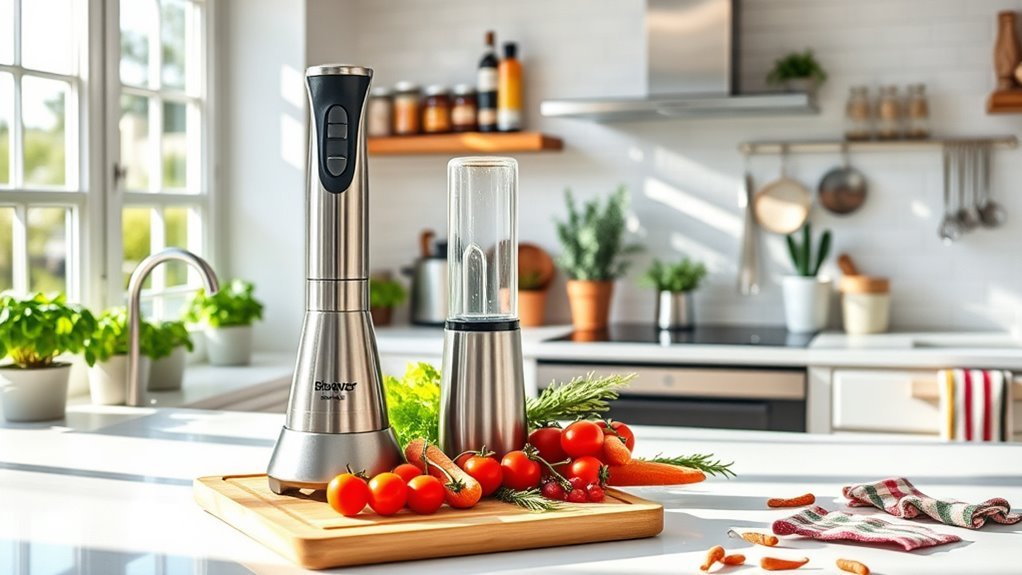
When it comes to making the perfect soup, how much power do you really need?

We’ve found that countertop blenders with their powerful motors (typically 500-1,800 watts) consistently outperform immersion blenders (200-750 watts) when preparing soups that require thorough blending.
While immersion blenders are handy for quick jobs, they often struggle with fibrous vegetables and larger batches of soup.
Take Kenmore’s models – their 1200W countertop blender achieves creamy perfection while their 400W hand blender might leave you with unwanted chunks.
For soup consistency, it’s really about power and capacity.
Countertop options like the Vitamix 5200 with its 1,380W motor can process up to 64 ounces without breaking a sweat, whereas – let’s be honest – immersion blenders are better suited for smaller, softer blending tasks.
High-performance blenders, exemplified by models with motor power exceeding 1,000 watts, also excel in handling hot liquids for smooth soup results.
Versatility in the Kitchen: Which Blender Type Offers More?
Why do we obsess over versatility in our kitchen gadgets? Well, it’s probably because we’re all trying to maximize functionality in our cooking spaces.
Immersion blenders win points for their space-saving design and ability to blend directly in pots—perfect for soups and sauces.
With attachments like whisks and food choppers, they’re ideal for small batches and spot texture adjustments at variable speeds.
Countertop blenders, on the other hand, excel at preparing large batches with hands-free operation.
You can—wait, you don’t have to—monitor them constantly!
Their powerful motors tackle frozen veggies for soups effortlessly, and many models feature pre-programmed settings that free you up for other tasks.
In our experience, immersion blenders edge out slightly for everyday versatility, but countertops are unbeatable for serious soup production.
Space Considerations: Storage Impact on Your Kitchen Setup
Kitchen real estate is precious, and the battle for counter space rages on in homes everywhere.
When choosing between stick blenders and traditional blenders for soup preparation, storage impact can make or break your workflow in compact kitchens.
- Immersion blenders slip easily into a drawer or cupboard, thanks to their narrow profile
- Countertop models demand dedicated space for both motor base and blending jar
- Stand blenders with 64-ounce pitchers can overwhelm smaller cabinets
- Stick blenders break down into compact pieces—perfect for kitchens where every inch counts
- Blending directly in a pot eliminates the need for extra counter space during preparation
We’ve found that immersion blenders are the clear winners for tight spaces.
Why struggle with bulky traditional blenders when you can achieve the same creamy soups with a tool that practically disappears when not in use?
For those prioritizing blending efficiency, high-performance blenders can provide smoother textures and handle tougher ingredients while still considering storage needs.
Batch Size Capabilities: Small vs. Large Soup Preparations
Beyond space savings, the quantity of soup you’re making greatly impacts which blender type serves you best. When deciding between an immersion blender vs a traditional blender, batch size should be a top consideration for your specific needs.
Immersion blenders excel with small batches, letting you blend directly in the pot without transferring hot liquids. Countertop blenders, on the other hand, are workhorses for big batches when feeding a crowd.
| Blender Type | Ideal Batch Size | Best Use Case |
|---|---|---|
| Stick/Immersion | 1-3 cups | Personal portions |
| Countertop | Up to 8 cups | Family meals |
| Both | Varies | Depends on recipe |
We’ve found that most home cooks actually benefit from owning both types of blender, especially if you make batches of smoothies regularly alongside soups.
Multitasking Features: How Each Blender Fits Your Cooking Flow
When multitasking in the kitchen becomes essential, your choice between immersion and countertop blenders can dramatically affect your cooking flow.
Both immersion blenders, also known as hand blenders, and countertop blenders provide distinct advantages for simplifying meal preparation.
- Countertop blenders feature programmed functions that allow you to blend soups hands-free, so you can tackle other recipe steps
- Immersion blenders save time by blending directly in cooking pots, eliminating the need to transfer hot liquids
- Stand blenders’ automatic shut-off protection guarantees reliable operation without constant monitoring
- One-touch modes with non-slip bases make countertop models ideal for unsupervised blending
- Immersion blenders’ interchangeable attachments let you switch between blending and whisking tasks quickly
We’ve found that choosing the right blender ultimately depends on how you prefer to move through your kitchen tasks.
Cleaning and Maintenance: Which Blender Is Easier to Care For?
After mastering the rhythm of cooking with your preferred blender, there’s another factor that’ll influence your long-term satisfaction: cleanup time.
When it comes to the main types of blenders, immersion blenders clearly win the maintenance battle.
You can rinse the detachable blending rod right away under water or pop it in the dishwasher.
Choose a Blender like Kenmore’s stick model, and you’ll spend under a minute on cleanup for most soups.
Countertop Blender options, well, they’re a bit more demanding.
Blenders also come with more parts to disassemble, and those jar crevices can be stubborn.
You know how it goes—you’ve got to scrub while soup residue hardens if you don’t clean your new blender immediately.
The right blender for easy maintenance? Immersion, hands down.
Price Points: Investment Value Between Immersion and Countertop Models
How much should you spend on a blender that’ll transform your soup game?
Well, it really depends on your specific needs.
Immersion blenders are known for their affordability, while countertop models come with more power for better results, especially when blending softer ingredients or making emulsified sauces.
- Immersion blenders cost between $30-$100, perfect for occasional soup makers
- Countertop models range from $50-$800, with good mid-range options around $100-$300
- Higher-end countertop blenders often include 7-10 year warranties, justifying their price
- Immersion blenders take up minimal storage space, adding to their value proposition
- Your budget should reflect how often the blender will be your go-to tool for culinary creativity
When it comes to blending investments, we’ve found that frequency of use is the deciding factor for most home cooks.
Texture Results: How Each Blender Affects Your Final Soup
The difference in texture between a soup blended with an immersion blender versus a countertop model might just be the deciding factor in your purchase.
Countertop blenders, with their powerful motors and multiple blades, create that silky-smooth consistency that’s perfect for sauces and purées.
They’ll blend right through tough ingredients like ice or frozen vegetables that might challenge other options.
Immersion blenders, well, they’re more about control.
We’ve found they’re ideal when you want to maintain some character in soft ingredients while still achieving a cohesive texture.
You can blend right in the pot, stopping when you’ve hit that perfect balance between chunky and smooth.
They won’t crush ice like their countertop cousins, but for most soups, that’s not what you’re after anyway.
Frequently Asked Questions
What Is the Best Blender for Blending Soups?
We’ve found 75% of chefs prefer immersion blenders for their safety features when handling hot soup. Blender power and blade design affect soup thickness, while capacity sizes determine which type suits your needs.
Are Immersion Blenders Good for Soups?
We’d highly recommend immersion blenders for soups. Their blending efficiency and heat handling let us achieve perfect soup smoothness without transfers, while easy cleanup, versatility, and safety measures make them practical kitchen tools.
What Are the Benefits of a Portable Blender Compared to an Immersion Blender?
We’re drowning in blender choices! Portable blenders offer travel benefits with grab-and-go cups, simpler cleaning methods, quieter noise reduction, and compact storage solutions—unlike immersion blenders that require separate containers for mobility.
Can I Use a Regular Blender Instead of an Immersion Blender for Soup?
Yes, we can use regular blenders for soup, though there are transfer steps and pouring challenges. Be mindful of heat hazards, verify lid security, and expect manual stirring for ideal soup texture and flavor retention.