
When it comes to kitchen equipment dilemmas, the blender battle sits high on our list of culinary conundrums. We’ve all faced that moment of indecision while shopping—do we go with the stick-style immersion blender or commit to a full-size countertop model? It’s not just about counter space or power, though those matter. The right choice depends on what you’re actually making, how often you’ll use it, and honestly, how much cleanup you’re willing to tackle after the cooking’s done.
Some of the links in this article may be affiliate links. If you make a purchase through these links, we may earn a small commission at no extra cost to you. Thank you.

What Is an Immersion Blender?

An immersion blender is one of those kitchen gadgets that doesn’t get enough credit for how useful it really is. Sometimes called stick or hand blenders, these compact tools let’s blend directly in pots, bowls, or cups without the mess of transferring hot ingredients to a countertop blender. We love how versatile they are! With attachments like whisks and choppers, they’re perfect for small batches of soups, sauces, and dressings. They typically run between 200-750 watts, which is ideal for processing softer ingredients but, well, not so great for crushing ice. The best part? Their slender design means they’ll fit in a drawer rather than hogging counter space. When you need quick, controlled blending without the cleanup, an immersion blender is honestly your best friend in the kitchen. For tougher tasks, consider upgrading to high-performance blenders like those from Vitamix for handling nuts and frozen fruits more effectively.
What Is a Countertop Blender?
The countertop blender stands as the kitchen workhorse we’ve all come to depend on for larger blending tasks.
It features a blending jar that sits securely on a motor base, creating a powerful station for whipping up everything from frozen drinks to creamy soups and sauces.
Traditional blenders typically include multiple speed settings that let you tackle different consistency needs.
What makes countertop blenders special:
- Powerful motors that can crush ice and blend frozen fruits with ease
- Larger capacity jars (usually 4-8 cups) perfect for family-sized smoothies
- Specialized settings for different textures—from chunky salsas to velvety purees
We’ve found that a good countertop blender is worth the counter space it occupies, especially if you’re regularly making smoothies or need to blend hot ingredients.
Moreover, some countertop blenders are high-performance options that offer enhanced durability and the ability to handle tough ingredients effectively.
Key Differences in Power and Performance

When comparing our kitchen blenders, power makes all the difference in what you’ll actually accomplish with each tool.
Countertop blenders pack a serious punch with motors ranging from 500 to 1,800 watts, making them champions at crushing ice and blending frozen ingredients.
Their immersion counterparts? They typically max out around 750 watts.
This power gap translates directly to performance.
We’ve found countertop models deliver better results with thorough blending of even the toughest ingredients, while immersion blenders work best with soft ingredients.
If you’re making batches of smoothies, a countertop blender like the Vitamix can process up to 64 ounces at once!
The immersion blender, though limited to smaller quantities, shines when you need quick processing right in your cooking pot.
Space and Storage Considerations
Size matters tremendously when you’re choosing between these kitchen workhorses.
Immersion blenders feature a space-saving design that’s perfect for kitchens where counter space is limited.
You can easily tuck stick blenders into a drawer or cupboard when not in use, while a countertop model demands a permanent spot in your kitchen landscape.
- Immersion blenders come with compact profiles—models like All-Clad with its 9.25-inch shaft fit practically anywhere
- Countertop blenders need dedicated space—think Vitamix 5200 taking up several square feet for hands-free operation
- Kenmore’s stainless steel hand blender disassembles into smaller pieces, making storage a breeze
When considering your specific needs, remember that portability might trump power if you’re working with minimal kitchen real estate.
We’ve found that tight spaces practically beg for an immersion option.
Energy Efficiency
Just like David versus Goliath, the battle between immersion blenders and their countertop cousins isn’t really about size—it’s about smarts. We’ve been analyzing the energy efficiency of both, and what we’ve found might surprise you. While that hulking countertop model looks impressive, it’s actually gobbling up to three times more electricity than its handheld competitor. Want to know how much money (and planet) you’re saving with your blending choice? Well, the numbers tell quite a story.
The surprising difference in power consumption between immersion and countertop blenders might just save you money on your electricity bill.
When we compare their wattage, the distinction becomes clear—immersion blenders typically operate around 400W while countertop models can draw a hefty 1200W.
This isn’t just about numbers on a label.
The compact design of immersion blenders translates to shorter blending times and substantially lower energy requirements.
We’ve found they’re remarkably efficient at handling softer ingredients with minimal power draw.
Think of it like this—countertop blenders are gas-guzzling SUVs, while immersion blenders are more like fuel-efficient compact cars.
Both get you where you need to go, but one’s definitely easier on resources for everyday trips. For more demanding blending needs, high-performance blenders can exceed 1,000 watts to handle tough ingredients effectively.
Wattage Comparison: Small vs. Large Motors
When comparing the motors that power these kitchen workhorses, it’s fascinating how the numbers tell such a clear story.
Immersion blenders typically feature smaller motors around 400W, making them more energy efficient for quick blending tasks like soups or smoothies.
Countertop blenders, with their large motors reaching 1200W, offer increased power but at a higher energy cost.
The difference in power consumption becomes obvious when we look at:
- Motor size – immersion blenders use 1/3 the wattage of countertop models
- Blending capacity – higher wattage enables ice crushing and frozen fruit processing
- Energy efficiency – smaller motors use less electricity for softer ingredients
We’ve found that choosing the right tool based on your needs actually saves both energy and frustration in the kitchen.
However, high-performance blenders can provide long-term value for frequent users due to their durability and efficiency in handling tough ingredients.
Energy Usage for Daily Blending Tasks
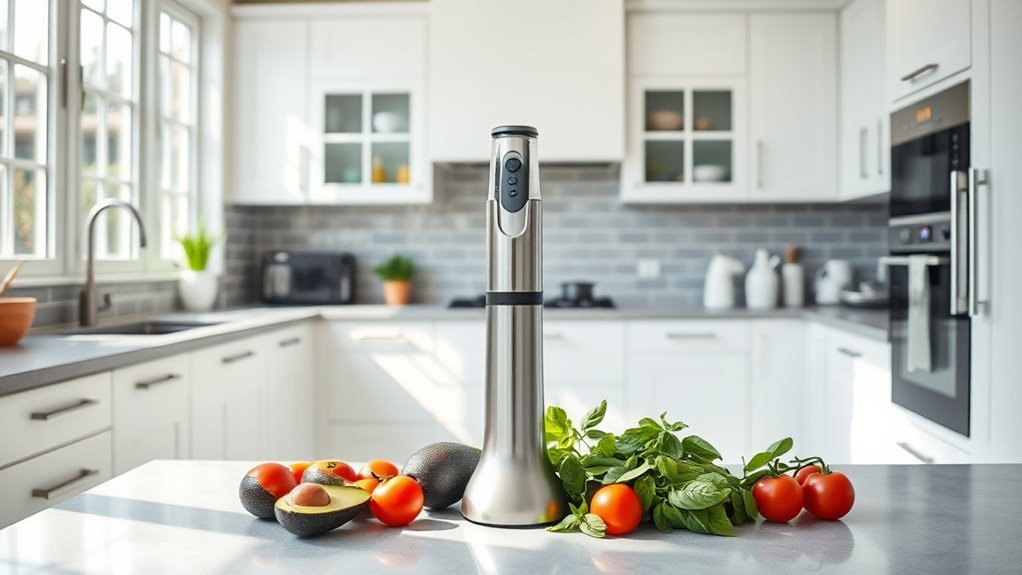
Now that we’ve learned the basic wattage differences, let’s look at how these numbers play out in your everyday kitchen routine. Smaller motors in immersion blenders aren’t just space-savers—they’re energy champions for daily tasks. When you’re pureeing softer ingredients like soups directly in the pot, that 400W immersion blender is doing exactly what you need without excess power consumption.
| Task | Immersion (400W) | Countertop (1200W) |
|---|---|---|
| Soup pureeing | Efficient | Overkill |
| Smoothies with ice | Struggles | Excels |
| Quick sauce blending | Perfect fit | Energy waste |
| Daily multitasking | Energy-efficient | Higher consumption |
We’ve found that for most daily blending tasks, immersion blenders offer more practical, energy-efficient operation. Save the countertop powerhouse for when you really need to pulverize those tougher ingredients!
The Environmental Impact of Your Blender Choice
Beyond our daily kitchen routines, how greatly does our blender choice impact the wider environment?
It turns out, quite substantially.
Immersion blenders with their smaller motors (around 400W compared to 1200W countertop models) create a perfect blend of efficiency and functionality.
Three key environmental advantages:
- Lower energy consumption means reduced greenhouse gas emissions
- Compact pieces require less counter space and fewer manufacturing resources
- Direct-in-pot blending means shorter operation times for kitchen prep
We’ve found that immersion blenders effectively tackle most blending needs while consuming substantially less power.
Their space-saving design isn’t just convenient—it represents a smaller environmental footprint from production to disposal.
When we’re making these kitchen purchases, sometimes the smaller appliance makes the bigger difference!
Cost Analysis: Long-term Energy Savings
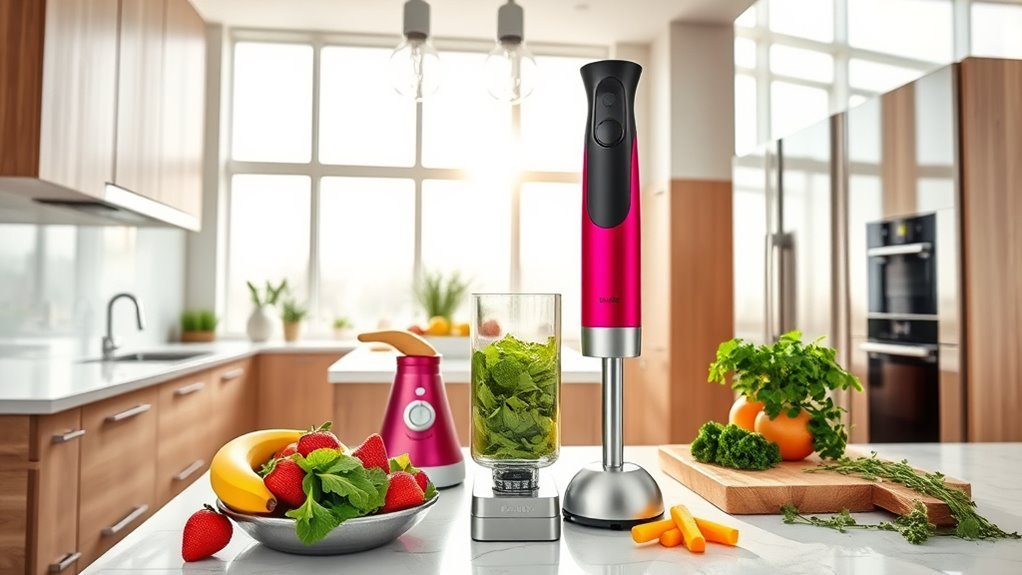
The dollars and cents of blender efficiency often reveal themselves only after months of use, but they’re worth examining closely.
When comparing immersion blenders to their countertop counterparts, the numbers are striking—a 400W hand blender uses roughly 70% less electricity than a powerful stand blender running at 1200W.
For households blending daily, this efficiency gap translates to about $20-50 in annual electricity costs saved.
Think about it—over five years, that’s potentially $250 back in your pocket!
Consumer efficiency ratings consistently show immersion blenders outperforming bulkier models, using 30-50% less power for equivalent tasks.
We’ve found that power usage estimates don’t lie—the long-term savings from choosing the right blender actually make a meaningful difference on your utility bills.
Versatility and Specialized Tasks

How does your ideal blender tackle the specific kitchen tasks you face most often?
When comparing immersion blenders vs countertop models, each shines in different scenarios.
Immersion blenders excel at creating emulsified sauces, whipped cream, and salad dressing directly in a pot or container.
We love how they eliminate transfer mess when blending batches of soup.
Countertop blenders, with their powerful motors (up to 1200W!), handle tougher jobs like Ice Crush functions for icy drinks.
They’re ideal for larger preparations—processing up to 8 cups at once.
Many models include programmed settings for hands-free operation.
Don’t overlook the versatility of attachments!
Immersion blenders often come with a food chopper or whisk, while countertop versions offer specialized functions for everything from smoothies to nut butters.
Cleaning and Maintenance Comparison
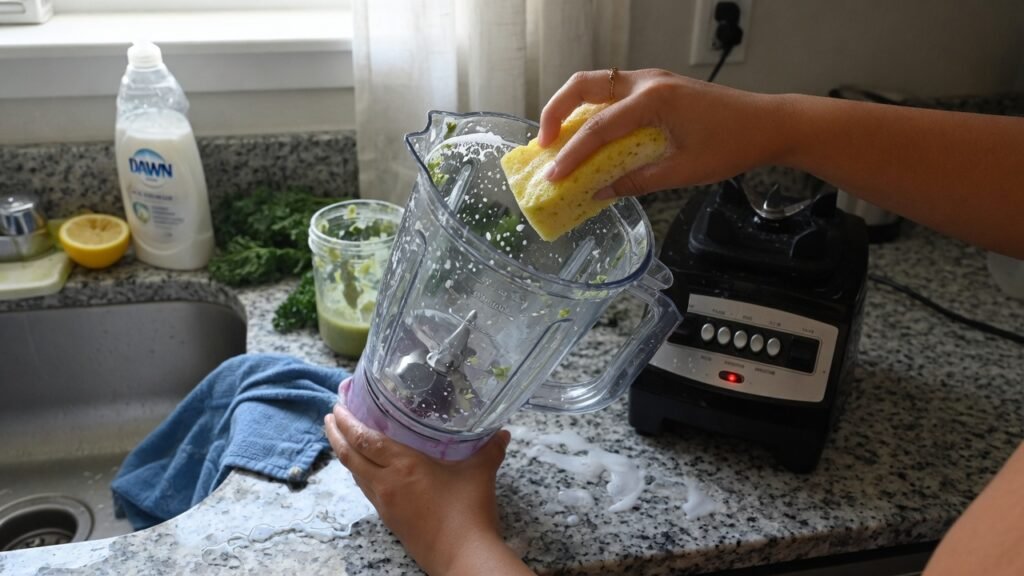
After exploring how each blender type handles different kitchen tasks, let’s tackle the inevitable aftermath—cleaning up.
In our experience, immersion blenders are the clear winners when it comes to maintenance.Their detachable parts make the cleaning process remarkably straightforward—just rinse under water or pop them in the dishwasher!
For immersion blenders, we’re looking at a pretty simple setup: a handle with a detachable blending shaft that you can rinse directly under water.Most models also come with attachments like a whisk or food chopper that pop off for easy cleaning.
Countertop blenders, on the other hand, have more parts to tackle. You’ll need to clean the pitcher, blades, and sometimes a removable vent cap from the lid. The motor base should never be submerged—just wipe it with a damp cloth.
We think the biggest difference is that immersion blender parts are smaller and designed for quick rinsing, while the pitcher of a countertop model can be, well, a bit more awkward to clean thoroughly, especially around those sharp blades.
Additionally, in high-performance countertop blenders, the sharp blades often require more careful cleaning to ensure they remain effective for tough ingredients.
What makes immersion blenders truly time-saving for cleanup:
- Simple construction means fewer places for residue buildup compared to countertop models
- You can blend directly in your cooking vessel, eliminating extra dishes
- Maintenance typically takes under a minute, while countertop blenders might need several minutes of scrubbing
Countertop blenders, while powerful, require more effort with their multiple components.
You’ll need to disassemble the pitcher and blades, and sometimes—well, let’s be honest—you might need special brushes to get into those tight spots.
Speed Factor: Time Required for Complete Cleaning
Now that we understand what parts need cleaning, let’s talk about something we all care about—time.
The difference here is pretty dramatic. Your immersion blender comes apart quickly, with compact pieces that typically take less than a minute to clean under running water.
Countertop blenders, however, demand 2-5 minutes of your time, with that bulky blending pitcher taking up space in your sink while you disassemble and scrub multiple components.
What makes immersion blenders ideal for busy cooks is how they feature a removable wand that’s cleaned in seconds versus countertop stand blenders with their pitcher taking up space and requiring individual attention for each part.
We’ve found that time for one simple rinse is often all you need—who doesn’t appreciate that efficiency?
For high-performance blenders, proper care like regular cleaning can help them last over a decade with minimal issues.
Stubborn Residue Challenge: Handling Difficult Ingredients
Beyond the basic cleaning methods we’ve discussed, certain ingredients present a unique challenge for both blender types. When you crush ice or blend sticky substances, residue can be a real headache! We’ve found immersion blenders typically handle stubborn ingredients better cleaning-wise because you can detach the shaft and rinse directly under water.
| Ingredient Type | Immersion Blenders | Countertop/Stand Blenders |
|---|---|---|
| Frozen Fruits | Easy direct rinse | Requires soaking |
| Crushed Ice | Quick shaft detachment | Residue traps in blades |
| Sticky Substances | Simple wipe-down | Multiple parts to clean |
The Kenmore immersion blender with its 400W motor and detachable parts makes cleanup after tougher ingredients like ice much simpler than the 64oz Kenmore stand blenders, which, despite their power, trap residue in hard-to-reach areas.
Which Blender Type Is Right for Your Kitchen Needs?
When deciding between immersion and countertop blenders, the question isn’t simply which is “better”—it’s about which one aligns with your specific cooking habits and kitchen setup.
If you’re regularly preparing large batches of smoothies or crushing ice, countertop blenders with powerful motors (like that 1,380-watt Vitamix) are your best bet.
They’re the kitchen appliances you’ll want for serious blending jobs.
On the flip side, if you’re tight on space or typically blend smaller portions, immersion blenders with their variable speeds might be perfect.
We’ve found that a stand blender makes sense when counter space isn’t an issue, while the handheld type of blender is ideal for apartments or minimalist kitchens.
When you choose a blender, think about what you’ll actually use it for—big batches or quick sauces?
Frequently Asked Questions
Is an Immersion Blender as Good as a Blender?
No. With countertop blenders offering up to 3x the BlendingPower (1800W vs. 750W), we’ll notice superior TextureResults. Immersion models excel in StorageOptions and PriceValue, but lack MotorStrength for demanding tasks.
When Not to Use an Immersion Blender?
We shouldn’t use immersion blenders for thick purees, frozen fruits, large quantities, dry ingredients like flour grinding, ice blending, dough mixing, nut butter, heavy loads, or prolonged blending tasks.
What Is the Difference Between an Immersion Blender and a Stand up Blender?
We’ve found immersion blenders offer portability for in-pot blending with various attachments, while stand-up blenders provide higher capacity, power, and speed controls but require more cleaning and counter space.
Is a Countertop Blender Better Than a Blender?
Like night and day, countertop blenders are generally better with higher power output, capacity size, and durability rating. We’d recommend them for versatility options, though they’re typically louder with more complex cleaning needs.